Many car owners believe PPF is a scam.
They have seen films turn yellow, peel from the edges or lose clarity within a year. After experiences like this, it is easy to assume paint protection film doesn’t really work.
But the real problem is something else.
Most standard car PPFs sold in India were never designed for Indian roads or climate. Heat, dust, pollution and debris create conditions that many films simply cannot handle.
This article explains why standard PPF fails in India and which best paint protection film in India is actually worth it.
Table of Contents
Why Many Indian Car Owners Think PPF Is a Scam?
Let’s address the elephant in the room.
Many car owners believe PPF coating for car paint is a scam.
Why?
Because their experience looked like this.
Common complaints car owners report
- Yellow tint within a year
- Edges lifting or peeling
- Visible film lines
- Scratches not healing
- Dust trapped under the film
- Film tearing easily
These problems are not rare.
In fact, they happen quite often with low-grade films or poorly engineered products.
But again, the root cause is simple.
Standard PPF is not built for Indian conditions.
And that brings us to the core of this article.
Why Standard PPFs Fail on Indian Roads
It’s important to note that not all PPFs fail nor are all PPFs a scam. It comes to the quality of PPF. And here’s why standard PPFs fail on Indian roads.
Reason 1: Indian Heat and UV Radiation Destroy Weak Films
Let’s start with the biggest enemy of car paint in India.
The sun.
During peak summer, road surface temperatures can cross 45°C.
Your car’s bonnet and roof absorb this heat continuously.
Now imagine a standard film sitting on top of that surface every single day.
If the film does not contain high-grade UV stabilisers, the polymer structure begins to break down.
This leads to one of the most common complaints among car owners have i.e PPF yellowing issues, especially when they drive lighter colour cars like white & silver.
Low-quality films often turn yellow because:
- UV rays degrade the polymer
- adhesives oxidise
- The top coat loses clarity
Research shows that strong sunlight exposure is one of the primary reasons many films lose transparency over time.
Once this happens, the film becomes visible on the car.
And on white or silver cars, the yellow tint becomes extremely obvious.
What a proper film should have
A high-performance paint protection film designed for hot climates must include:
- advanced UV inhibitors
- non-yellowing aliphatic TPU
- high-clarity top coating
Without these, yellowing is just a matter of time.
Reason 2: Indian Roads Are Rough
Most global PPF brands design their films for smooth highways.
But Indian roads are unpredictable.
Every drive exposes your car to:
- gravel
- sand
- broken asphalt
- construction debris
- small stones kicked up by trucks
These particles hit the car at high speed.
When that happens, the film must absorb kinetic energy.
If the film is too thin or weak, it simply tears.
This is why many car owners complain that their scratch-resistant car film gets damaged easily.
Standard films often lack:
- sufficient thickness
- tensile strength
- impact resistance
Which means instead of protecting the paint, the film itself fails.
Reason 3: Dust and Pollution in India Are Brutal on Car Surfaces
India has some of the most polluted urban environments in the world.
Cities like Delhi, Mumbai and Ahmedabad experience extremely high levels of airborne particles.
These include:
- brake dust
- industrial pollutants
- construction particles
- soot
- chemical contaminants
These particles constantly settle on your car.
And if the film has a porous or weak top coat, the contaminants start embedding into the surface.
Over time, this leads to:
- dull-looking paint
- stains inside the film
- reduced clarity
Pollution and dirt accumulation are also known to accelerate film discolouration and degradation.
A well-engineered car PPF needs a dense, non-porous top layer that prevents contaminants from penetrating the surface.
Unfortunately, many standard films skip this.
Reason 4: Hard Water Washing Ruins Weak PPFs
In many Indian cities, the water used for washing cars contains high mineral content.
These minerals include:
- calcium
- magnesium
- salts
When water evaporates, these minerals stay behind.
On paint, they create water spots.
But on low-quality PPF, the problem becomes worse.
Minerals slowly etch into the film surface, leaving permanent marks.
And because many roadside car washes use harsh detergents, the film’s protective coating wears down even faster.
This combination of hard water + strong chemicals drastically reduces PPF durability in India.
Reason 5: Weak Adhesives That Are Not For All Seasons
Most people focus only on the film layer when they think about paint protection film.
But there is another component quietly doing the heavy lifting.
The adhesive.
Every car PPF uses a pressure-sensitive adhesive that bonds the film to the paint. If this adhesive is poorly engineered, the film will eventually start failing.
Now let’s think about Indian weather.
Unlike some countries where temperature changes drastically within a day, India experiences long seasonal cycles.
A car may spend months exposed to:
- 40-48°C summer heat
- heavy monsoon humidity
- dust-heavy winters
This prolonged exposure slowly stresses the adhesive layer.
Here is what happens when the adhesive is not designed for these conditions :
During peak summer, the temperature of a parked car’s panels can exceed 40°C, which may soften low-quality adhesives and cause issues like edge lifting, bubbling or film movement. During the monsoon, high humidity and moisture can weaken poor adhesive bonds, leading to moisture pockets, cloudy patches and premature edge lifting.
Reason 6: Many PPFs Sold in India Use Inferior TPU Material
Here is a truth the industry does not openly discuss.
Not all TPU is the same.
TPU stands for Thermoplastic Polyurethane, the core material used in paint protection film.
However, TPU quality varies massively depending on how it is manufactured.
There are three common types used in the industry.
| Material Type | Quality Level | Typical Problems |
|---|---|---|
| PVC Films | Very Low | Turns yellow quickly, cracks, poor durability |
| Aromatic TPU | Medium | Better flexibility but prone to yellowing |
| Aliphatic TPU | High | Excellent clarity, UV resistance, long durability |
Many budget films sold as car PPF actually use aromatic TPU or blended TPU.
This material performs decently in moderate climates.
But under intense UV exposure and heat, it begins to degrade faster.
That is when people experience:
- PPF yellowing issues
- surface dullness
- reduced self-healing ability
On the other hand, aliphatic TPU is specifically engineered to resist UV degradation. It maintains clarity for years.
This material difference is one of the biggest factors affecting PPF durability in India.
Reason 7: Poor Installation Amplifies Film Failure
View this post on InstagramA post shared by Vibrant Autotech - CarzSpa Jaipur Ajmer Road (@vibrantautotech_carzspa_jaipur)
Even the best paint protection film in India will fail if the installation is done poorly.
And unfortunately, improper installation is extremely common.
PPF installation requires:
- controlled indoor environment
- dust-free workspace
- trained installers
- precise cutting patterns
If any of these steps are compromised, problems start appearing soon.
Common installation mistakes
- Dust trapped under the film
- Stretching the film excessively
- Poor edge wrapping
- Improper surface preparation
- Using blades directly on paint
These mistakes reduce the life of the PPF coating for car paint.
For example, overstretching the film weakens its molecular structure.
That area then becomes more prone to tearing and lifting.
This is why serious PPF brands work only with trained installation partners rather than allowing random installers to apply their films.
What Makes the Best Paint Protection Film in India?
After understanding the failures, the next logical question is simple.
What should a PPF actually have to survive Indian conditions?
A high-quality car paint protection film must include the following features :
1. High Grade Aliphatic TPU
This ensures:
- long-term clarity
- resistance to yellowing
- flexibility under heat
2. Advanced UV Stabilisation
India receives intense sunlight throughout the year.
Without UV stabilisers, the film begins to degrade quickly.
3. Strong Adhesive Technology
The adhesive must tolerate:
- extreme temperature fluctuations
- humidity
- water exposure
4. Thick Impact Resistant Film
A thicker film improves resistance against:
- stone chips
- gravel damage
- road debris
5. Dense Top Coat Protection
A durable top coat protects the film against:
- pollution
- bird droppings
- chemical stains
- hard water marks
When these features combine properly, the result is a scratch-resistant car film that actually works on Indian roads.
Introducing Aegis Paint Protection Film for Indian Conditions
Now comes the important part.
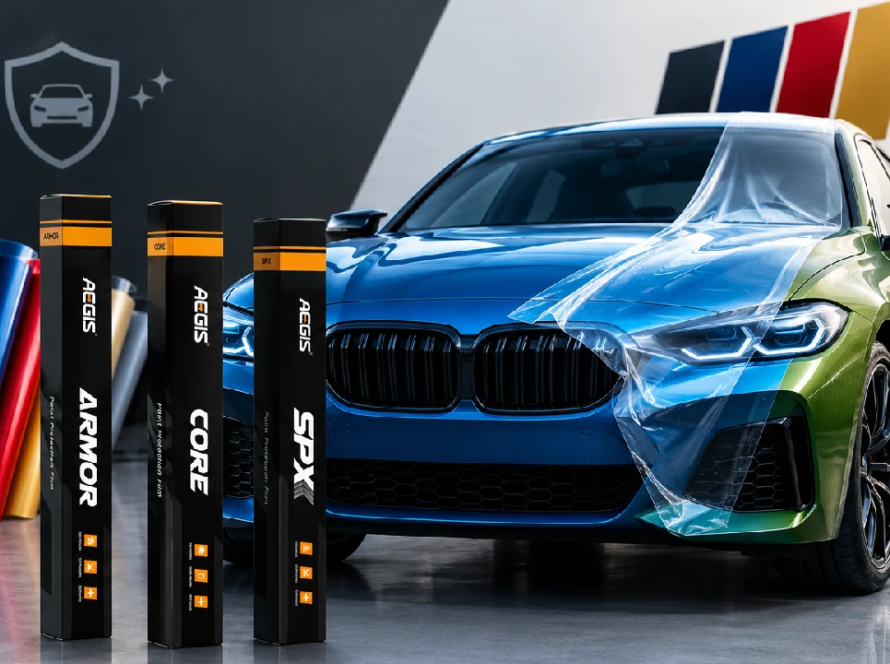
While many best PPF brands sell films originally developed for western climates, Aegis Paint Protection Film has been engineered keeping extreme heat in mind, which makes it the best paint protection film in India.
Here’s why you should choose Aegis Films :
1. Advanced Aliphatic TPU Construction
Aegis paint protection film uses high-clarity aliphatic TPU, which helps maintain transparency even under harsh sunlight.
This significantly reduces PPF yellowing issues.
Your car’s paint continues to look fresh and glossy for years.
2. Strong Multi-Layer Film Structure
Aegis films use a carefully engineered layered structure:
| Layer | Function |
|---|---|
| Self-Healing Top Coat | Removes minor scratches with heat |
| UV Resistant Layer | Prevents discoloration |
| High Strength TPU | Absorbs road impact |
| Premium Adhesive | Ensures strong bonding |
This multi-layer design dramatically improves PPF durability in India.
3. Superior Scratch Resistance
Daily driving exposes cars to constant micro scratches.
Parking lot incidents, tree branches and dust particles during washing.
Aegis film includes advanced self-healing technology.
When exposed to sunlight or warm water, minor scratches gradually disappear.
This helps maintain the original finish of the car.
4. Protection from Road Debris
Indian roads can be unpredictable.
Gravel, sand and debris often strike the car’s surface.
Aegis car protection film acts as a sacrificial layer that absorbs these impacts.
Instead of damaging the paint, the film takes the hit.
5. Long-term Clarity and Gloss
One of the biggest fears among car owners is that PPF will make the car look dull.
High-quality films actually do the opposite.
Aegis PPF coating for car paint enhances the depth and gloss of the paint while keeping the film nearly invisible.
The car continues to look exactly the way it should.
Just better protected.
Final Thoughts
Indian roads are tough.
Dust, heat, pollution and debris constantly attack your car’s paint.
Without protection, the paint slowly loses its shine and value.
Many car owners dismiss paint protection film because they have seen poor-quality films fail.
But the problem is not PPF itself.
The real problem is using films that were never designed for Indian conditions.
When engineered correctly, car paint protection film becomes one of the most effective ways to preserve your vehicle’s finish.
Films like Aegis paint protection film combine strong TPU materials, advanced adhesives and durable top coats to withstand the challenges of Indian roads.
And when installed properly, they ensure your car stays protected, glossy and beautiful for years.
Frequently Asked Questions
1. Is PPF coating for car worth it in India?
Yes, but only when high-quality films are used. Low-grade films often fail due to heat, UV exposure and pollution. Choosing the best paint protection film in India ensures long-lasting protection.
2. Does car PPF turn yellow over time?
Inferior films may develop PPF yellowing issues due to UV degradation. High-quality films made with aliphatic TPU are designed to resist yellowing even under intense sunlight.
3. How long does paint protection film last in India?
A good car protection film typically lasts between 5 to 10 years, depending on film quality, installation and maintenance.
4. Is PPF better than ceramic coating?
Ceramic coatings mainly provide gloss and water repellency. Paint protection film offers physical protection against scratches and stone chips, making it more effective for protecting the paint.
5. Which is the best PPF brand in India?
The best PPF brands use high-quality TPU material, advanced adhesives and durable top coats. Films such as Aegis paint protection film are designed to perform reliably in Indian driving conditions.