If your car gets hot in the Indian summer, you may come across three terms: window tint, sun control film and safety glazing film. They are often used interchangeably, but they do not all mean the same thing.
Quick Answer
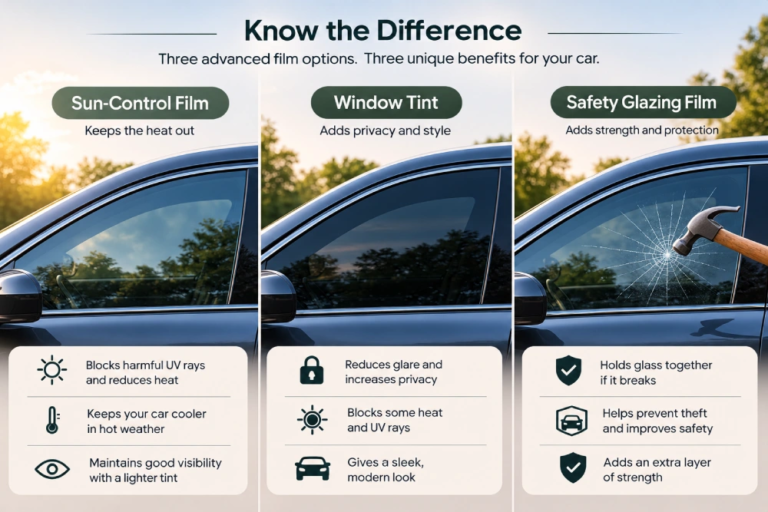
Sun control film is designed to manage solar energy entering the cabin, window tint usually describes how dark the glass or film looks, and safety glazing film is intended to help hold glass fragments together if the glass breaks. These functions can overlap in one product. What matters is the film’s documented performance, its suitability for automotive glass and the rules that apply where you drive.
Table of Contents
What Is Sun Control Film for a Car?
Sun control film for car windows is a thin layer applied to glass to manage the solar energy entering the cabin. Depending on its construction and specifications, it may reduce heat transmission, ultraviolet (UV) transmission and glare.
Films may use dyed, carbon, ceramic or metallised constructions. Some metallised films may affect signal transmission, so check the exact product specifications. The Aegis Sun Protection Film range is available in ceramic and carbon variants.
No film can promise a fixed drop in car cabin heat. Results depend on the film, glass, sunlight, parking and ventilation.
Is Sun Control Film the Same as Window Tint?
Not exactly, although sellers often use the terms interchangeably. Window tint usually refers to how much visible light a film or glass blocks and how dark it looks. Sun control film describes its purpose: managing solar energy. A film can look relatively clear and still offer solar control, while a darker film is not automatically better at rejecting heat.
Check the product’s performance data and intended use rather than relying on the label.
| Term | What it usually means | Main job |
|---|---|---|
| Sun control film | A film selected for solar performance, such as heat and glare control | Manage UV rays entering the cabin |
| Window tint | Darkened glass or film; also used informally for many types of window film | Reduce visible light and change the glass's appearance |
| Safety glazing film | A film intended to help hold glass fragments together | Help retain fragments after breakage |
These categories can overlap. Certainly, Aegis sun protection films co
What Is Safety Glazing Film?
Safety glazing film is designed to help hold glass fragments together if the glass breaks. It does not make glass unbreakable. Its performance depends on the product, the glass and the installation.
Safety glazing film is not the same as the toughened or laminated glass fitted by a vehicle manufacturer. In India, automotive safety glazing is covered by IS 2553 (Part 2): 2019. A product label alone does not prove that the film-and-glass combination is compliant or legal.
Does Darker Window Film Reduce More Heat?
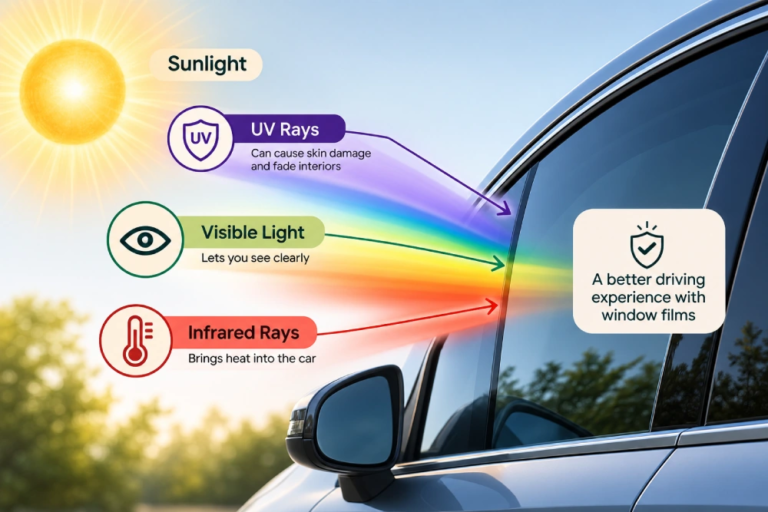
Not necessarily. Darkness tells you how much visible light passes through, but sunlight also includes ultraviolet and infrared energy. To compare car window film, look at the specifications together rather than judging by appearance alone.
- VLT (visible light transmission): The percentage of visible light that passes through. Lower VLT generally means darker glass or film.
- TSER (total solar energy rejected): The proportion of total solar energy rejected across the measured solar spectrum. It is a useful overall figure for comparing solar heat rejection, provided the products were tested on a comparable basis.
- Infrared performance: Covers only part of the solar spectrum, and the wavelength range used for the measurement matters.
- UV rejection: Relevant to UV exposure and protection of interior materials, but it is not a complete measure of heat control.
- Glare and clarity: Check how well you can see through a sample in daylight and at night.
Product-specific lab figures are not a promise of the temperature drop in your car.
Also read: Best Window Film for a Car in India to Control Sun Rays?
Is Sun Control Film Legal in India?
Check the legal position before buying. Court decisions and amendments have affected how aftermarket films are treated, so older online articles may not reflect the full position.
The VLT limits. Rule 100 of the Central Motor Vehicles Rules, 1989 sets minimum visible light transmission (VLT) levels of 70% for the windscreen and rear window and 50% for side windows. The glass must meet applicable safety-glazing requirements, including IS 2553 (Part 2): 2019.
The 2012 Supreme Court ruling. In Avishek Goenka v. Union of India (27 April 2012), the Supreme Court held under the then Rule 100 that black films of any VLT, or other material pasted on vehicle safety glass, were not permitted. It distinguished these from compliant tinted glass manufactured as part of the vehicle’s glazing.
The 2020 amendment and 2024 Kerala ruling. Notification GSR 457(E) amended Rule 100 from 1 April 2021 to recognise safety glazing alongside safety glass, subject to requirements and VLT limits. In George & Sons v. Union of India (10 September 2024), the Kerala High Court considered the amended rule and quashed challans in the case before it.
What does this mean for car owners? The Kerala decision does not, by itself, settle how the amended rule will be interpreted or enforced across India. The interaction between the rule, the standard and aftermarket films remains legally complex. Do not assume every product described as sun control film or safety glazing film is permitted.
What about “RTO approved sun control film for car”? Under Rule 100 of the Central Motor Vehicles Rules, the windscreen and rear window must allow at least 70% of visible light to pass through, while side windows must allow at least 50%.
What Should You Check Before Choosing a Car Window Film?
Before choosing an automotive window film, check:
- Purpose: Heat control, UV reduction, glare control and glass-fragment retention are different functions.
- Specifications: Compare TSER, VLT, UV and infrared figures. Check the infrared wavelength range and what glass the film was tested on.
- Can you see clearly through it? Check a sample for haze or distortion in daylight and at night.
- Is it suitable and documented for automotive use? Ask for test reports for the exact product and glass-film combination.
- What is the legal position? Check the applicable standard, combined glass-and-film VLT and your state’s current guidance.
- Documentation: Request the specification sheet, test report, invoice and written warranty terms.
A verbal assurance or “RTO approved” label is not enough.
Bringing It All Together
Sun control film manages solar energy, window tint describes darkness and safety glazing film helps hold broken glass together. Since these products can serve different purposes, compare documented heat rejection, visibility and safety specifications rather than judging a film by how dark it looks. Before installing any film, check the applicable Indian regulations and ask for the relevant test documentation.
Looking for sun protection for your car? Explore Aegis Sun Protection Film and speak to your nearest CarzSpa studio about the available options, product specifications and documentation for your vehicle.
You might also like: Benefits of RTO-Approved Sun Control Film
Frequently Asked Questions
1. Does the Kerala High Court ruling apply across India?
No. It does not automatically settle the legal position nationally. Check current guidance before installation.
2. Can I put sun control film on the front windscreen?
Rule 100 specifies minimum VLT levels of 70% for the windscreen and rear window and 50% for side windows. Confirm whether your chosen film is permitted under current requirements before installing it.
3. Is safety glazing film the same as the safety glass fitted in my car?
No. Safety glass is fitted by the manufacturer. Safety glazing film is an added layer intended to retain fragments after breakage. The name alone does not prove compliance with the automotive standard.
4. Does a film with high UV or infrared rejection keep the car cooler?
Not necessarily. UV and infrared measure only parts of the solar spectrum. Compare TSER too, using figures measured on a comparable basis.