Buying a new car is one of those moments most enthusiasts never forget. You remember the delivery day photos. You remember the smell of the new interior. You remember taking the longest route home just to spend more time behind the wheel.
Interestingly, most buyers spend weeks or even months researching which car to purchase. They compare engines, variants, fuel economy figures, safety ratings and features. Then the moment the car arrives, the research stops.
That is where many owners make expensive mistakes.
The first month of ownership has a bigger impact on your car’s long-term condition than most people realise. The decisions you make during these first few weeks can influence engine health, paint condition, insurance protection, maintenance costs and even resale value years later.
Whether you have bought a hatchback, sedan, SUV or luxury vehicle, there are certain things every owner should do immediately after taking delivery.
This guide walks you through the ten most important steps.
Table of Contents
- Why Should You Follow This Checklist in the First 30 Days of Buying a New Car?
- Verify Every Document Before You Leave the Dealership
- Read the Owner’s Manual
- Follow the Break-In Period Religiously
- Get Your Car PPF Done On Day 1
- Upgrade Your Insurance With the Right Add-Ons
- Set Up a Regular Tyre Pressure Routine
- Learn Your Car’s Features Properly
- Schedule and Never Skip the First Free Service
- Install a Dash Cam and Cabin Air Filter
- Establish a Cleaning and Paint Maintenance Routine
- Conclusion
- Frequently Asked Questions
Why Should You Follow this Checklist is First 30 Days Of Buying New Car

A new car leaves the showroom in its best possible condition.
The paint has not been exposed to harsh sunlight for years. The engine components are still settling in. The tyres are fresh. The interior is untouched.
Once the vehicle hits Indian roads, things change quickly.
Daily exposure to dust, UV radiation, stone chips, bird droppings, hard water stains, tree sap, road debris and unpredictable traffic conditions begins affecting the vehicle from day one.
At the same time, many important ownership tasks happen during the first month:
- Documentation verification
- Insurance upgrades
- First service scheduling
- Paint protection decisions
- Learning vehicle features
- Establishing maintenance routines
Owners who handle these tasks early usually enjoy a smoother ownership experience and spend less money fixing avoidable issues later.
Let’s start with the most overlooked step.
1. Verify Every Document Before You Leave the Dealership
Most buyers focus entirely on the car during delivery. They inspect the paint, take photographs, collect the keys and drive away.The paperwork often gets only a quick glance.
That can become a problem later. Before leaving the dealership, make sure you receive and verify all essential documents.
Documents You Should Check
| Document | Usually Available on Delivery Day |
|---|---|
| Tax Invoice | Yes |
| Insurance Policy | Yes |
| Temporary Registration | Usually Yes |
| Warranty Documents | Yes |
| PUC Certificate | Usually Yes |
| Delivery Note | Yes |
| RC Smart Card | Usually No |
The Registration Certificate is often processed after delivery. Depending on the state and RTO workload, the physical RC smart card may take anywhere from a few weeks to around 45-60 days to arrive.
Before signing any delivery paperwork, verify:
- Vehicle Identification Number (VIN)
- Engine number
- Chassis number
- Variant name
- Fuel type
- Registration details
- Insurance details
Even a small error can create complications during future insurance claims, resale transactions or warranty work.
Set Up DigiLocker Immediately
Many vehicle-related documents can now be accessed digitally.
Setting up DigiLocker early provides convenient access to:
- Driving licence
- Registration certificate
- Insurance information
- PUC certificate
This reduces the risk of losing physical documents and makes roadside verification easier.
Common Delivery-Day Mistakes
Some owners discover months later that:
- Insurance details contain errors
- Warranty information was not properly activated
- Temporary registration documents are missing
- Vehicle details do not match the invoice
A simple 15-minute document review can prevent hours of frustration later.
2. Read the Owner's Manual
Most people never read their owner’s manual.
The manual usually gets pushed into the glovebox and forgotten until a warning light appears on the dashboard.
That is unfortunate because the owner’s manual contains some of the most useful information about your vehicle.
Manufacturers spend thousands of hours developing each model. The manual is essentially a guide written by the people who know the car best.
Hidden Information You Might Miss
Inside the manual, you will find:
- Recommended tyre pressures
- Fuel specifications
- Service schedules
- Warning light explanations
- ADAS operating limitations
- Towing instructions
- Battery maintenance guidelines
- Load capacity limits
Many drivers rely on internet forums for answers that are already explained in the manual.
Every Manufacturer Has Different Recommendations
Two SUVs may look similar but have completely different maintenance requirements. One manufacturer may recommend tyre rotation every 10,000 km. Another may recommend it at 5,000 km.
One engine may require premium fuel under certain conditions. Another may not. The owner’s manual removes the guesswork.
Ask experienced car enthusiasts and you’ll notice something interesting.
Many of them read the owner’s manual before they even take delivery.
Why?
Because understanding how your vehicle is designed helps you get the best performance, efficiency and longevity from it.
Spending one evening with the manual can save you years of confusion.
3. Follow the Break-In Period Religiously
Modern engines are manufactured with incredible precision. However, that does not mean the running-in period has become irrelevant.
Many enthusiasts still follow a break-in routine because it helps engine components settle correctly during their early life.
Most manufacturers recommend a running-in period of approximately 1,000 to 1,500 kilometres.
The exact distance varies by manufacturer, so always check your owner’s manual.
What Happens Inside a New Engine?
During the initial kilometres, several components continue adapting to each other.
This includes:
- Piston rings
- Cylinder walls
- Bearings
- Transmission components
- Brake surfaces
As these components settle, proper driving habits help ensure even wear patterns.
Think of it as allowing the mechanical parts to become familiar with each other under controlled conditions.
Best Practices During the Break-In Period
Avoid treating your new car like a race car immediately after delivery.
Instead:
- Keep engine RPM moderate
- Avoid full-throttle acceleration
- Vary vehicle speeds
- Avoid extended idling
- Avoid towing heavy loads
- Minimise harsh braking where possible
- Avoid maintaining constant RPM for very long periods
One common misconception is that highway cruising is ideal during break-in.
In reality, varying engine speeds is generally more beneficial than maintaining a single RPM for hours.
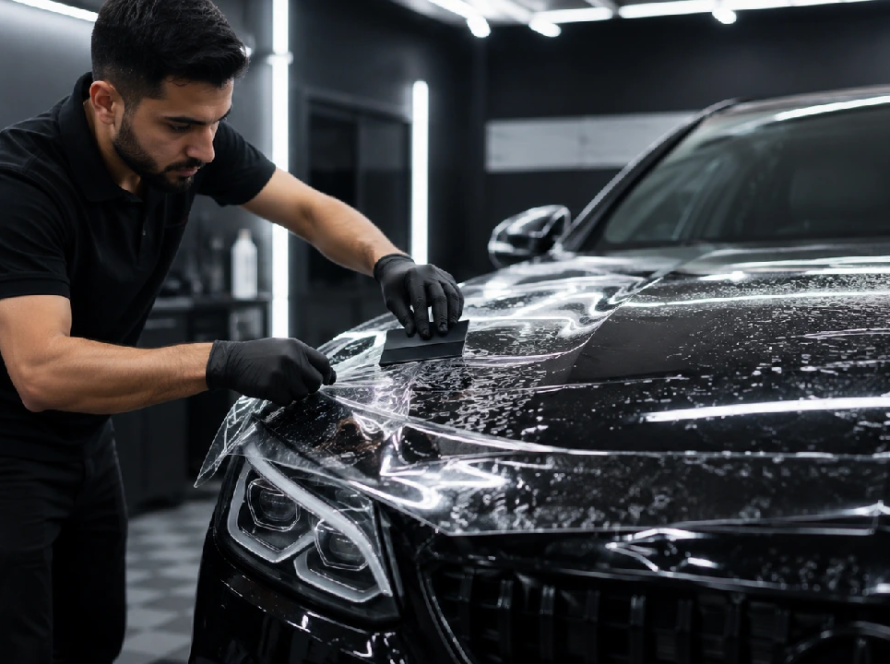
4. Get Your Car PPF Done On Day 1
Every day your car spends on the road exposes the paint to new risks.
Even a short highway trip can leave behind:
- Stone chips
- Road debris impacts
- Bug splatter
- Tar contamination
- Hard water spots
Many of these marks cannot be completely prevented once the paint is exposed. Installing car PPF early helps create a physical barrier before the damage occurs.
Think of it as prevention rather than correction. Because your paint is constantly exposed to:
- Loose gravel
- Construction debris
- Intense summer heat
- UV radiation
- Monsoon contaminants
- Bird droppings
- Tree sap
- Dust and pollution
Even careful drivers cannot avoid these hazards completely.
The problem becomes more noticeable on darker paint colours, where scratches and swirl marks stand out immediately.
5. Upgrade Your Insurance With the Right Add-Ons
Here is something most new car buyers do not know: the insurance policy that comes bundled with your car from the dealership is almost always the most basic compliant version. It covers third-party liability (as required by law), but the own-damage coverage and add-ons are often bare-bones.
The most important upgrade to make within the first month is adding a Zero Depreciation (Zero Dep) cover, also called bumper-to-bumper insurance.
Under a standard comprehensive policy, when you make a claim for accident damage, the insurer deducts depreciation from the value of damaged parts before settling the claim. Plastic parts, rubber components and fibre panels depreciate at 25-50% in the very first year. So if your bumper (worth ₹10,000) gets damaged, you might only receive ₹5,000 from the insurer and you pay the rest out of pocket.
With Zero Dep, the depreciation deduction is waived and you receive the full replacement cost. The additional premium is typically between ₹800 and ₹4,000 per year depending on your car’s IDV, a small amount given what it covers.
Alongside Zero Dep, also consider a Return to Invoice cover (pays the full ex-showroom price if the car is stolen or totalled), an Engine Protection cover (covers damage from hydraulic lock or oil leakage) and a Roadside Assistance add-on if your manufacturer’s warranty does not already include 24×7 assistance.
Zero Dep is available as an add-on for cars up to 5 years old, so the first year is the best time to add it.
6. Set Up a Regular Tyre Pressure Routine
Tyres are the only part of your vehicle that remains in contact with the road. Yet tyre pressure is one of the most neglected maintenance items among Indian drivers.
A simple monthly routine can improve:
- Fuel efficiency
- Ride quality
- Tyre life
- Braking performance
- Handling stability
Check Pressure Monthly
Tyre pressure naturally changes over time.
Temperature fluctuations can also influence readings.
Checking pressure once a month takes only a few minutes but can significantly affect vehicle performance.
Don't Ignore the Spare Wheel
Many owners diligently monitor all four tyres and completely forget the spare.
Then a puncture occurs and the spare is underinflated.
Include the spare wheel in every inspection.
What About TPMS?
Tyre Pressure Monitoring Systems are extremely useful.
However, they should not replace manual checks entirely.
TPMS alerts you when pressure drops below a threshold. It does not eliminate the need for routine inspection.
7. Learn Your Car's Features Properly
This one is for the enthusiasts. You spent hours comparing variants, watching spec-sheet breakdowns and reading reviews about which trim level has the better ADAS suite and then you drive the car for six months without actually using half of it.
Spend an afternoon genuinely learning your car’s feature set. Set up Android Auto or Apple CarPlay properly. Understand how your drive modes work and what changes between Eco, Normal and Sport (throttle response, steering weight, gearbox behaviour, it varies by car). If you have an automatic transmission, understand the manual mode or paddle shifters.
More importantly, if your car has ADAS features, understand their operating parameters. Features like Lane Departure Warning, Automatic Emergency Braking (AEB), Blind Spot Monitoring and Rear Cross-Traffic Alert are only useful if you know when they activate and when they do not. For instance, AEB on most systems does not function below certain speeds and Lane Departure Warning requires clear lane markings to work. These are not limitations to be frustrated about, they are things to know so you can drive intelligently with the technology.
Also explore your infotainment system thoroughly. Set up your preferred routes in the navigation app, connect your phone via Bluetooth, enable the dashcam integration if your car supports it and go through the settings menus. You paid for these features, you might as well use them.
8. Schedule and Never Skip the First Free Service
By the time your new car reaches its first service milestone, you may feel everything is running perfectly. The engine feels smooth, the brakes work well and there are no warning lights on the dashboard.
That is exactly why some owners postpone or completely skip the first service.
Unfortunately, that can be a costly mistake.
The first service is not simply a routine check-up. It is an important inspection that allows technicians to identify minor issues before they become major problems.
Most manufacturers schedule the first service at either: 1 month after delivery or around 1,000 km driven, whichever comes first.
Always confirm the exact interval in your owner’s manual. While procedures vary by manufacturer, technicians typically inspect:
| Inspection Area | What Gets Checked |
|---|---|
| Engine Oil | Condition and level |
| Coolant | Level and leaks |
| Brake System | Performance and fluid levels |
| Battery | Charging health |
| Tyres | Pressure and wear patterns |
| Suspension | Visual inspection |
| Filters | Condition check |
| Electronics | Error codes and system scans |
Many owners are surprised to learn that the first service is often more about inspection and preventive maintenance than replacing parts.
Why Is This Service Important?
During the break-in period, engine components are settling into their operating patterns.
Service technicians can identify:
- Fluid leaks
- Loose fasteners
- Software updates
- Sensor calibration issues
- Abnormal tyre wear
Problems caught early are usually easier and cheaper to resolve.
9. Install a Dash Cam and Cabin Air Filter
The first month of ownership is also a good time to make a few practical upgrades that can improve safety and comfort every single day. Two of the most useful are a dash cam and a quality cabin air filter.
Why Every New Car Should Have a Dash Cam
Indian roads can be unpredictable. Even the most careful driver cannot control the actions of others. A dash cam provides an objective record of events.
This can be extremely useful for:
- Insurance claims
- Accident disputes
- Fraudulent claims
- Hit-and-run incidents
- Parking damage investigations
The footage can often provide clarity when witness accounts differ.
Front vs Front-and-Rear Dash Cam
A front camera is better than no camera.
However, a dual-channel setup provides more comprehensive coverage.
| Dash Cam Type | Coverage |
|---|---|
| Front Only | Records forward incidents |
| Front + Rear | Records both front and rear events |
For many owners, the additional cost of a rear camera is worth the extra protection.
Don't Overlook Cabin Air Quality
Indian roads expose vehicles to significant levels of:
- Dust
- PM2.5 particles
- Pollen
- Industrial pollution
- Construction debris
Many modern vehicles include cabin filters from the factory.
However, not all filters provide the same level of protection.
A higher-quality filter can help improve cabin air quality, particularly for:
- Daily commuters
- Families with children
- Elderly passengers
- People with allergies
Since you’ll spend hundreds of hours inside the vehicle each year, cabin comfort deserves attention too.
10. Establish a Cleaning and Paint Maintenance Routine
Many owners spend lakhs on a new vehicle and then unknowingly damage the paint during routine washing.
Ironically, some of the most visible paint defects are not caused by road debris.
They are caused by improper cleaning methods.
The first month is the perfect time to establish good habits.
The Biggest Mistake: Waiting Until the Car Looks Dirty
Dirt, dust, bird droppings, tree sap and industrial fallout do not simply sit on the surface. Many contaminants can gradually affect paint if left unattended for long periods.
Regular cleaning helps prevent this build-up. The goal is not obsessive washing.
The goal is consistent maintenance.
A Basic Safe Washing Routine
Use:
- pH-neutral car shampoo
- Clean microfibre towels
- Separate wash and rinse buckets
- Dedicated wheel-cleaning tools
Avoid:
- Household detergents
- Old cloth rags
- Dirty sponges
- Excessive pressure while wiping
Small improvements in washing technique can dramatically improve paint condition over the years.
How PPF Makes Maintenance Easier
This brings us back to one of the most important decisions discussed earlier.
A vehicle protected with paint protection film is generally easier to maintain because the film acts as the sacrificial layer.
Instead of contaminants interacting directly with paint, they interact with the protective film.
This can help:
- Simplify cleaning
- Reduce minor wash marks
- Preserve gloss
- Maintain appearance over time
That is one reason many enthusiasts choose PPF Coating early in ownership rather than waiting for visible damage to appear.
Conclusion
Buying a new car is only the beginning of the ownership journey.
What happens during the first month often determines how the vehicle will look, feel and perform years down the road.
The owners who enjoy the best long-term ownership experience are rarely the ones who spend the most money. They are usually the ones who make the right decisions early.
Verifying documentation, following the break-in period, maintaining tyre health, understanding vehicle technology, upgrading insurance coverage, attending the first service and establishing proper cleaning habits all contribute to a smoother ownership experience.
Most importantly, remember that your car’s paint starts facing challenges from the moment it leaves the dealership. Stone chips, road debris, UV exposure, bird droppings, hard water stains and daily wear are unavoidable realities of Indian driving conditions.
That is why many enthusiasts choose to install paint protection film during the first month itself rather than waiting for damage to appear. A high-quality solution such as Aegis Films helps create a protective barrier between your vehicle and the road, allowing the paint to retain its appearance for years to come.
Your new car will never be newer than it is today.
Protect it well, maintain it consistently and the rewards will be visible every time you walk back to it in a parking lot, even years from now.
Frequently Asked Questions
1. Is PPF coating worth it for a new car?
For owners who want to preserve paint condition and reduce the impact of stone chips, minor scratches, UV exposure and environmental contaminants, PPF Coating can be a worthwhile long-term investment.
2. What is the difference between full body PPF and partial PPF?
Full body PPF protects nearly all painted exterior surfaces, while partial PPF focuses on high-impact areas such as the front bumper, bonnet, fenders and ORVMs.
3. How much does partial PPF cost?
Partial PPF cost varies based on coverage area and vehicle size. Front-end protection packages generally cost significantly less than full body PPF while still protecting the most vulnerable panels.
4. How long does paint protection film last?
Premium paint protection film products typically last several years when properly maintained. Actual lifespan depends on usage conditions, maintenance habits and film quality.
5. Does PPF affect the original paint?
A high-quality film installed correctly should not negatively affect factory paint. In fact, its primary purpose is to help preserve the original finish.