Most guides on how to remove scratches from car paint jump straight to a fix. Rub on a compound, try a household hack or use a touch-up pen.
But the fix that works on one scratch can make another one worse.
The difference usually comes down to one thing: how deep the scratch actually goes.
Before you try to remove a car scratch, identify what part of the paint has been damaged. A mark sitting on the clear coat needs a very different approach from one that has reached the primer or bare metal.
This guide walks you through that process, so you can understand the damage first, choose the right repair method and know when DIY repair is no longer worth the risk.
Table of Contents
- Quick Answer
- How to Tell How Deep a Car Scratch Is
- Is It Really a Scratch? Common Marks That Look Like Scratches
- How to Remove Small Scratches From a Car
- How to Remove Deeper Scratches From Car Paint
- Does Toothpaste Really Remove Car Scratches?
- How Much Does Car Scratch Repair Cost in India?
- When Should You Stop DIY Car Scratch Repair?
- Common Car Scratch Removal Mistakes to Avoid
- Can You Prevent Car Scratches Instead of Repairing Them?
- Final Takeaway
- FAQs
Quick Answer
Yes, many car scratches can be removed or significantly improved, but the right method depends on how serious the damage is.
A scratch limited to the clear coat can often be improved with careful polishing. A scratch that reaches the colour coat, primer or bare metal needs a different repair method and may require professional attention.
Diagnosing the scratch before trying to remove it is the most important step.
How to Tell How Deep a Car Scratch Is
Think of your car’s paint as several layers rather than one solid surface.
From the outside, you generally have:
- Clear coat: The transparent protective layer you see and touch.
- Colour coat: The layer that gives the car its colour.
- Primer: The layer underneath that helps the paint adhere to the body.
- Metal or body panel: The underlying surface.
A scratch can affect one or several of these layers.
The deeper it goes, the less likely polishing alone will fix it.
1. Run Your Fingernail Over the Scratch
Gently run your fingernail across the mark.
- If your nail glides over it, the damage may be limited to the surface or clear coat.
- If your nail catches slightly, the scratch may have gone deeper.
- If it catches noticeably, polishing alone is unlikely to restore the damaged area.
This is a useful first check, not a definitive paint inspection.
2. Check the Scratch After Wetting It
Clean the area and apply a small amount of water.
If the mark becomes much less visible while wet, the damage may be mainly within the clear coat.
If the scratch remains clearly visible, especially if you can see another colour underneath, it may have gone deeper.
3. Look at the Colour Inside the Scratch
The colour you see inside the scratch can also give you a useful indication.
If you still see the car’s original paint colour, the damage may be limited to the clear coat.
If you see a grey or white layer, you may be looking at primer.
If you see a bright metallic surface, the scratch may have reached the underlying metal.
These tests are useful indicators, but they are not a substitute for a professional paint inspection.
Quick Scratch Diagnosis
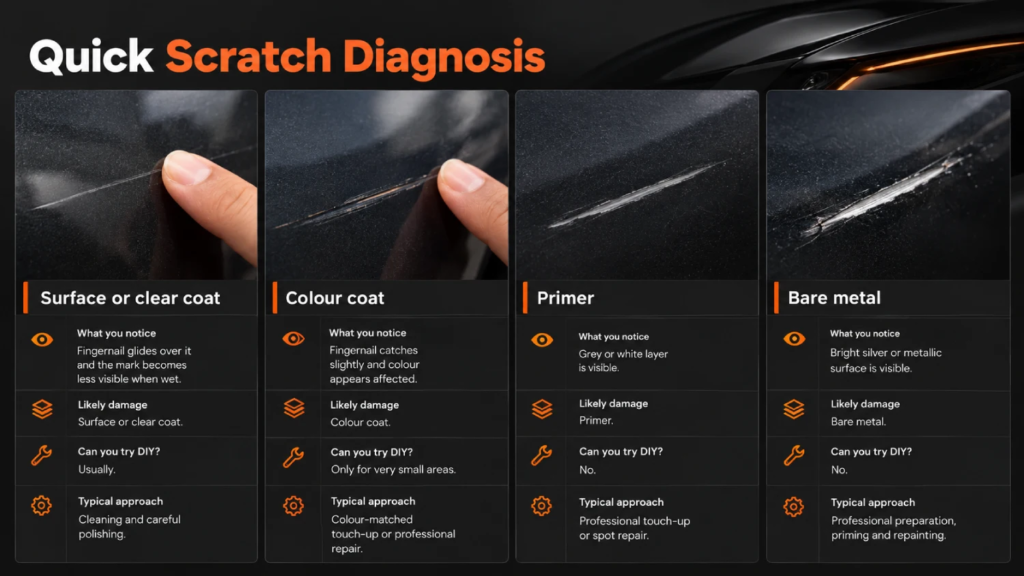
The basic rule is simple: don’t try to polish away paint that is no longer there.
Is It Really a Scratch? Common Marks That Look Like Scratches
Not every mark on your car is an actual paint scratch.
Before reaching for a polish or rubbing compound, check whether you’re dealing with something sitting on top of the paint rather than damage to the paint.
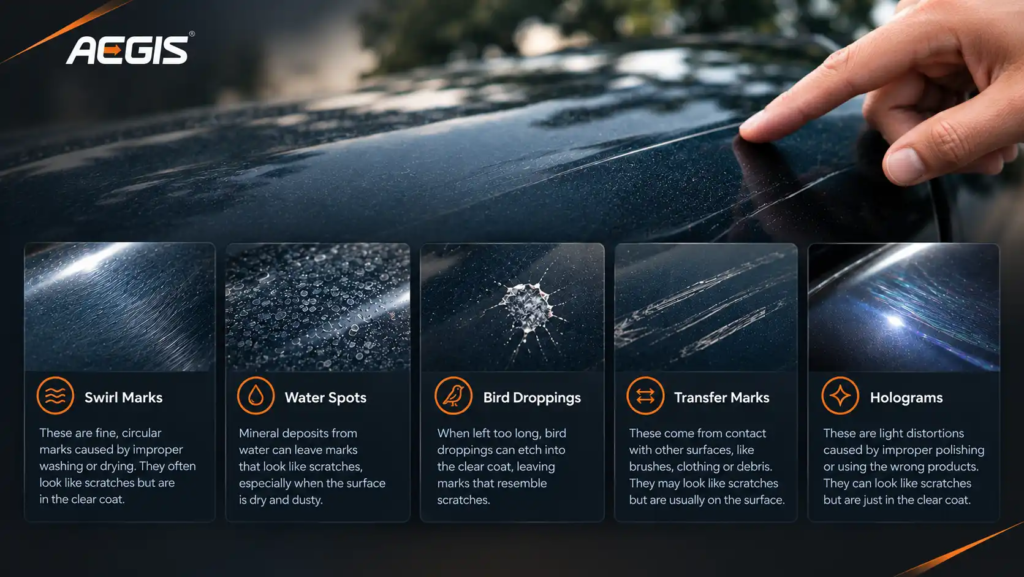
Paint Transfer
Another object’s paint can transfer onto your car during a light collision or scrape.
The mark may look like a deep scratch even when your own paint underneath is relatively intact.
Surface Scuffs
Plastic, rubber or other materials can leave a visible scuff without cutting deeply into the paint.
Swirl Marks
Fine circular marks are often caused by washing, drying or polishing techniques. They are different from a single deep scratch and usually need paint correction rather than spot repair.
Water or Mineral Marks
Dried water deposits can leave visible spots or streaks that may look like paint damage.
Cleaning the area properly first can prevent you from performing unnecessary paint correction.
How to Remove Small Scratches From a Car
If you’ve confirmed that the damage is limited to the clear coat, you may be able to improve it yourself.
The goal is not to aggressively remove the scratch. It is to carefully reduce the visibility of the damaged area without unnecessarily removing surrounding clear coat.
Step 1: Clean the Area
Wash the affected section with an automotive shampoo and clean water.
Dry it with a clean microfiber towel.
Dirt or grit left on the surface can create additional marks while you work.
Step 2: Inspect the Scratch Again
Once the surface is clean and dry, inspect the scratch in good lighting.
You may find that some of what looked like a scratch was actually transferred material or surface contamination.
Step 3: Choose the Least Aggressive Suitable Method
For a light clear-coat scratch, a suitable automotive polish or paint correction product may be enough.
Start with the least aggressive option that can reasonably address the mark.
Step 4: Work on a Small Area
Apply the product to a small section rather than working over the entire panel immediately.
Use controlled pressure and follow the product’s instructions.
Step 5: Inspect Before Repeating
Wipe the area clean and check the result.
If the scratch has become less visible, you may not need to keep polishing.
Repeated polishing simply because the mark is still slightly visible can remove more clear coat than necessary.
Step 6: Protect the Finish
Once the area has been corrected, apply an appropriate protective product according to its instructions.
The important point is restraint.
How to Remove Deeper Scratches From Car Paint
Deeper scratches are different because some of the paint has already been removed.
Polishing can improve the appearance of surface-level damage, but it cannot replace missing colour coat or primer.
If the Colour Coat Is Damaged
If the scratch has removed some of the car’s colour, you may need a colour-matched touch-up or spot repair.
Getting the colour and finish right can be difficult, especially with metallic, pearlescent or other specialised finishes.
For visible damage on a prominent panel, professional repair is usually the safer option.
If the Scratch Has Reached the Primer
A primer-level scratch needs more than polishing.
The damaged area may need preparation, touch-up or refinishing followed by the appropriate paint layers and clear coat.
If Bare Metal Is Visible
If you can see bright metal through the scratch, don’t keep polishing it.
The damaged area needs to be properly prepared and refinished.
If you can see primer or metal, don’t keep trying to polish the scratch away. Polishing cannot replace paint that has already been removed.
If bare metal is exposed, leaving the damage untreated can also allow corrosion to develop when the surface is exposed to moisture and the elements.
Does Toothpaste Really Remove Car Scratches?
You’ve probably seen toothpaste recommended as a cheap way to remove a car scratch.
There is a small amount of logic behind the idea. Some toothpastes contain mild abrasives that can make an extremely light surface mark less noticeable.
But toothpaste is not a dedicated automotive paint correction product.
It cannot replace missing paint and it is not a reliable solution for deeper scratches.
If the damage is limited to the clear coat, use a product designed for automotive paint and follow its instructions rather than relying on a household hack.
Toothpaste may temporarily improve the appearance of an extremely light surface mark, but it is not a proper repair method for deeper car paint scratches.
How Much Does Car Scratch Repair Cost in India?
There is no single car scratch repair cost because the repair depends on what has actually been damaged.
A small clear-coat mark may only need polishing. A deeper scratch can require sanding, colour matching, repainting and clear coating.
As an indicative guide:
| Type of Damage | Indicative Repair Range in India |
|---|---|
| Very Light Surface Marks | ₹500–₹2,000 |
| Clear-Coat Scratches | ₹1,000–₹4,000 |
| Small Colour-Coat Scratches | ₹1,000–₹3,500 |
| Deeper Scratch on One Panel | ₹3,500–₹9,000 per panel |
| Severe Damage Across Multiple Panels | ₹10,000–₹30,000+ |
| Full-Body Repaint | ₹25,000–₹95,000+ |
These are indicative ranges, not fixed market prices.
The final price can vary based on:
- Scratch depth and size
- Number of affected panels
- Vehicle type
- Paint type and finish
- Whether spot repair or full-panel repainting is required
- Workshop quality
- City and local labour rates
Luxury vehicles, metallic or pearlescent paints, larger panels and higher-end workshops can cost significantly more.
For an accurate quote, the workshop needs to inspect the actual damage rather than estimating from a photograph alone.
When Should You Stop DIY Car Scratch Repair?
DIY repair makes sense when the damage is minor and you understand what you’re working with.
But there is a point where continuing can make the repair more expensive.
Stop and consider professional help if:
- You can see primer or bare metal.
- The scratch covers a large area.
- Multiple panels are damaged.
- Paint has chipped away.
- The surface needs sanding and you are unsure how much material to remove.
- You have polished the area carefully once or twice with little improvement.
- You are unsure whether the clear coat is already thin or damaged.
- The repair requires blending paint into surrounding panels.
The simplest rule is:
If fixing the scratch requires replacing paint rather than correcting the surface, it is no longer a simple DIY polishing job. It’s better to choose your nearby detailing studio like CarzSpa.
Common Car Scratch Removal Mistakes to Avoid
A scratch can become more difficult to repair when the removal process is too aggressive.
Polishing a Dirty Surface
Even small particles trapped between the pad or cloth and the paint can create additional marks.
Applying Too Much Pressure
More pressure does not automatically mean better correction.
Work gradually and inspect the result.
Repeatedly Polishing a Deep Scratch
If the scratch has gone beyond the clear coat, polishing more aggressively will not bring the missing paint back.
Sanding Without Knowing the Paint Layer
Wet sanding can be useful in professional paint correction, but it removes material from the surface.
Doing it without understanding the paint system can create a larger repair problem.
Using Household Chemicals
Not every cleaning or abrasive product is suitable for automotive paint.
Use products designed for the surface you’re treating.
Confusing Paint Transfer With a Scratch
Always clean and inspect the area first.
You may be trying to remove something that is sitting on top of your paint.
Trying to Repair Severe Damage Yourself
Large scratches, exposed primer, bare metal and multi-panel damage are better assessed by a professional.
Can You Prevent Car Scratches Instead of Repairing Them?
Scratch repair is reactive.
You wait for the damage to happen, then decide how to fix it.
Paint protection takes a different approach by adding a protective layer over the painted surface.
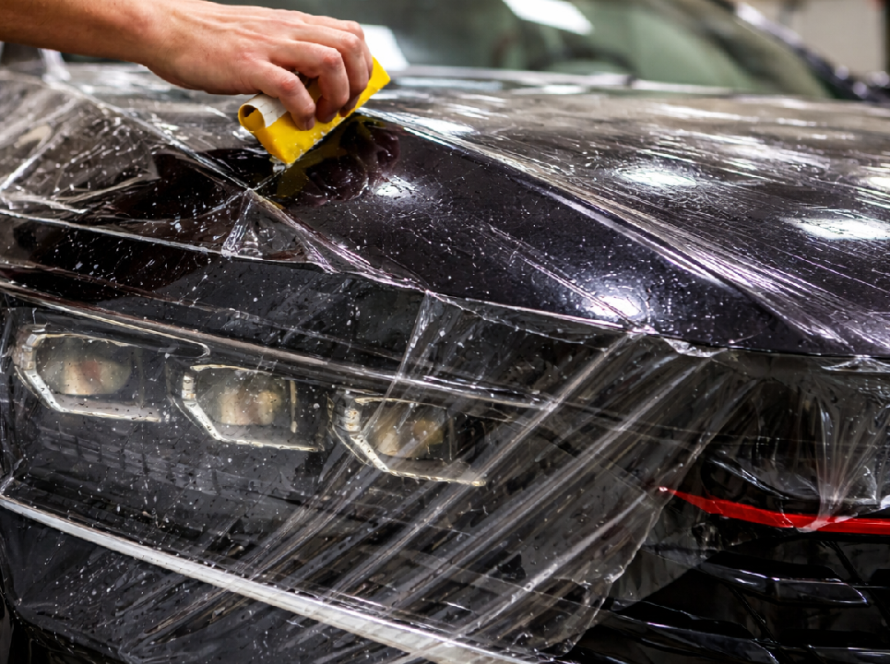
Paint Protection Film (PPF) is a transparent protective film designed to help protect a vehicle’s paint from everyday surface damage.
It does not make a car completely scratchproof.
However, depending on the film and the type of contact involved, PPF can help reduce the impact of everyday risks such as minor scuffs, light marks and road debris.
Some modern PPF products also use self-healing top coats that can reduce the appearance of certain light surface marks when exposed to heat.
For someone who has just spent money repairing scratches, this is where prevention becomes relevant.
Instead of repeatedly asking how to remove scratches from car paint, you can also ask:
How can I protect the paint from getting damaged in the first place?
That’s where PPF becomes part of the conversation.
Final Takeaway
A scratch does not automatically mean your car needs repainting.
First identify what has been damaged. Then choose the least aggressive repair method that can safely address it.
If the damage is limited to the clear coat, careful polishing may be enough. If paint has been removed, polishing cannot replace it. And if you want to reduce the risk of dealing with the same problem again, paint protection can be considered as a preventive layer.
Repair the scratch you have. Protect the paint you want to keep.
FAQs
1. Does WD-40 get rid of scratches on cars?
No. WD-40 does not remove scratches from car paint. It can temporarily make a light surface mark look less noticeable by adding a layer of oil, but it does not repair the damaged paint or clear coat. For genuine scratches, the right solution depends on how deep the damage is.
2. Which scratch remover is best for a car?
The best scratch remover depends on the depth of the scratch. For very light clear-coat scratches, a quality automotive scratch remover or polishing compound can reduce their appearance. If the scratch has gone through the clear coat or exposed the base coat or metal, a scratch remover alone will not restore the paint. In that case, professional paint correction or touch-up may be needed.
3. Does Vaseline help get rid of car scratches?
No. Vaseline cannot remove or repair car scratches. Like other oily products, it may temporarily make a shallow mark appear less visible by filling or coating the surface, but the scratch is still there. For a lasting result, first identify whether the mark is only on the clear coat or has damaged the paint underneath.
4. Can small scratches be removed from a car at home?
Yes, some small scratches can be improved at home if they are limited to the clear coat. Clean the area first, assess the depth and use a suitable automotive polishing product. If the scratch reaches the colour coat, primer or metal, professional repair may be required.
5. Does toothpaste actually remove car scratches?
Toothpaste may make an extremely light surface mark less noticeable because some formulas contain mild abrasives. It cannot repair deeper scratches or replace missing paint, so it should not be treated as a proper car scratch repair method.
6. How do I know if a car scratch is too deep to polish?
Run your fingernail across the scratch and inspect its colour. If your nail catches and you can see the colour coat, primer or bare metal, polishing alone is unlikely to fix it. A scratch showing primer or metal should be professionally assessed.
7. How much does it cost to repair a scratch on a car in India?
A minor surface mark may cost a few hundred to a few thousand rupees to correct, while deeper panel-level repairs can cost several thousand rupees. Larger repairs or repainting multiple panels can cost significantly more. The exact car scratch repair cost depends on the depth, size, paint finish, vehicle and repair method.
8. Can PPF prevent scratches on car paint?
PPF can help protect painted surfaces from many types of everyday minor damage, but it does not make a car completely scratchproof. The level of protection depends on the film, installation and type of impact. Some PPFs also have self-healing top coats that can reduce certain light surface marks.