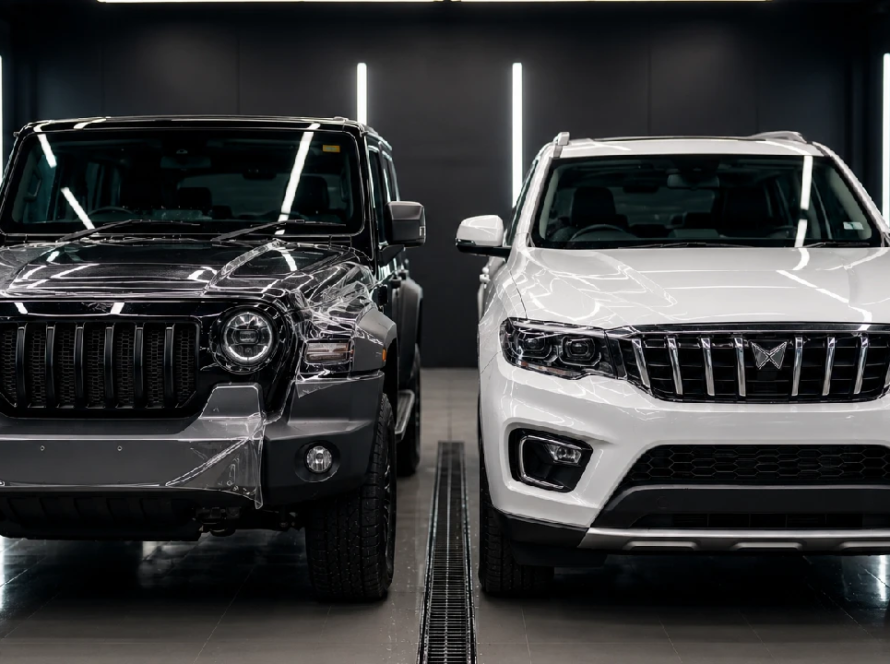
You drive your new car out of the showroom and the paint looks flawless. The sun catches the hood and you can see your own reflection in it. Three days later, a stray stone on the highway leaves a chip on the front bumper.
Every car owner in India knows this moment. Once you have lived through it, you start taking paint protection seriously.
Two options come up again and again: paint protection film (PPF) and ceramic coating. Both protect your car’s paint, and detailing studios across the country recommend both. But PPF vs ceramic coating is not a question with one universal answer. These products solve different problems, and the right choice depends on how you drive, where you park and how long you plan to keep the car.
Key Takeaway
- PPF protects against physical damage: stone chips, scratches and highway debris. Ceramic coating protects against sun, water and dirt, and adds gloss.
- For cars under ₹10 to ₹12 lakh used mainly in the city, ceramic coating is usually the practical choice.
- For higher-value cars, long-term ownership or highway driving, PPF is the stronger investment, and pairing it with a ceramic top coat gives you both benefits.
- TPU (thermoplastic polyurethane) is the film material behind quality PPF. It stays flexible and resists yellowing better than cheaper PVC or TPH films.
- Micron is a unit of thickness (one-thousandth of a millimetre). PPF at 150 to 200 microns is roughly 50 to 100 times thicker than a ceramic coating layer, which is why it absorbs impact and ceramic coating does not.
Table of Contents
- PPF vs Ceramic Coating: Which Is Better for Your Car?
- What Damages Car Paint in India?
- What Is Paint Protection Film (PPF)?
- What Is Ceramic Coating for Cars?
- Paint Protection Film vs Ceramic Coating: Category-by-Category Comparison
- Where Ceramic Coating Makes Sense
- Where PPF Becomes the Smarter Choice
- Why Owners Choose Aegis for PPF and Ceramic Coating
- In Conclusion
- FAQs
PPF vs Ceramic Coating: Which Is Better for Your Car?
What Damages Car Paint in India?
Before comparing the two products, it helps to understand what your paint is actually up against. Indian roads and climate put paint under more pressure than most factory clear coats are built to handle.
- Road shrapnel: Whether it is the Bangalore-Mysore highway or construction debris in Hyderabad, your car takes hits daily. Sand and gravel strike your bumper at speeds the factory paint was never designed to absorb.
- Heat: Rajasthan and North India see summers past 48°C. That level of UV exposure oxidises paint over time and leaves it looking dull and chalky.
- The chemical mix: Coastal cities like Mumbai and Chennai bring salt-laden air. Add bird droppings and acid rain during the monsoon, and you get a combination that eats into your clear coat within hours if left uncleaned.
- Tight parking: Parking in India means narrow gaps, overenthusiastic valets and the occasional autorickshaw mirror. Your car takes small hits from multiple directions, not just the road.
What Is Paint Protection Film (PPF)?
Paint protection film is a transparent thermoplastic polyurethane (TPU) film that a certified installer applies over your car’s paint. It is not a coating and not a wax. It is a physical layer, roughly 150 to 200 microns thick, sitting directly on top of your paint like invisible armour.
Modern car PPF typically includes:
- A self-healing top coat
- UV inhibitors
- A hydrophobic surface
- An impact-absorption layer
- An adhesive layer engineered for safe removal
People in India often use “PPF coating for car” to describe this process. Technically, PPF is a film rather than a coating, but the term has stuck in the local market.
How PPF actually works: when a stone hits your car, the film absorbs the impact and spreads that energy across the polyurethane layer instead of letting it reach the paint. Minor scratches often disappear on their own once heat reactivates the self-healing top layer. That is physics, not marketing. If you drive the Mumbai-Pune Expressway regularly, you already know stone chips are not a hypothetical risk. Without PPF, your paint takes that hit directly. With it, the film takes the hit instead.
What Is Ceramic Coating for Cars?
Ceramic coating for cars is a liquid polymer that chemically bonds with the paint and forms a nano-level protective layer, usually 1 to 3 microns thick. Compare that with the 150 to 200 microns of PPF and the difference in scope becomes clear immediately.
Ceramic coating for cars gives you:
- Hydrophobic water beading
- A noticeable gloss boost
- UV resistance
- Light resistance to chemical staining
It does not add meaningful impact resistance. If a stone hits a ceramic-coated panel, the paint underneath still chips. Ceramic coating genuinely improves gloss and makes washing easier, but it is not armour, and no honest studio should sell it as one.
Paint Protection Film vs Ceramic Coating: Category-by-Category Comparison
Here is a full paint protection film vs ceramic coating breakdown across the six factors that matter most for Indian roads and climate.
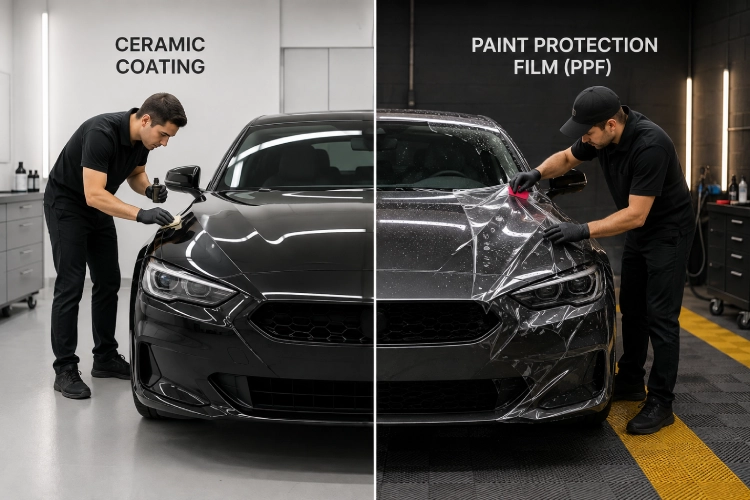
1. Stone Chip Protection
This is the most misunderstood part of the comparison. When a small stone hits your car at highway speed, it transfers energy into the clear coat. Indian OEM clear coats typically run 30 to 50 microns thick, which is not much material to absorb an impact.
Ceramic coating adds only 1 to 3 microns of cured layer on top of that. Even with a small increase in surface hardness, the layer is too thin to absorb meaningful energy, so the force travels straight into the clear coat. If that force exceeds the paint’s elastic limit, it chips. No coating changes that basic physics.
PPF, at 150 to 200 microns, behaves differently. On impact, the thermoplastic layer deforms slightly and spreads the energy sideways within the film before it reaches the paint. In most cases, that is enough to prevent the clear coat from cracking.
If highway debris, gravel and bumper chipping worry you the most, ceramic coating will not solve that problem. Properly installed PPF does.
2. Scratch Resistance
Scratches happen through micro-abrasion (dust, improper washing, dry-cloth wiping, car covers rubbing against trapped grit) and through deeper mechanical contact.
Ceramic coating makes the surface slicker and harder, which reduces light swirl marks from washing. But it still sits directly on the clear coat, so once a scratch goes deeper than a few microns, it reaches the paint underneath.
PPF adds a thick, elastic, sacrificial layer instead. Light scratches usually stay on the film surface, and self-healing films correct minor swirl marks with heat, whether from the sun or warm water. This does not mean PPF stops every scratch. A deep gouge can still cut through the film. But for daily-driven cars in dense city traffic, the difference between the two shows up within the first year.
3. Gloss and Surface Finish
Ceramic coating fills microscopic pores in the clear coat and increases light reflectance, which produces sharper, deeper gloss, especially on dark colours.
Modern PPF has closed most of that gap. Earlier film generations muted gloss slightly, but current premium films offer optical clarity close to ceramic coating, and some gloss films even create a deeper “wet” look because of their top coat structure.
Where PPF pulls ahead is finish flexibility. It can convert a glossy factory finish to satin or matte without repainting, something ceramic coating cannot do since it only enhances the finish that already exists. If pure initial gloss is your only priority, ceramic coating may edge ahead in controlled lighting. If you want gloss and physical protection together, PPF gives you both.
4. PPF vs Ceramic Coating Cost in India (2026)
PPF vs ceramic coating cost in India is where the two options diverge most, and it is worth being upfront about the range rather than quoting one misleading number.
Professional ceramic coating in India generally runs from about ₹8,000 to ₹50,000 or more, depending on car size, coating grade and the number of layers. A hatchback typically sits at the lower end, while an SUV or luxury car with a multi-layer, higher-grade product sits toward the top.
Car PPF costs generally range from ₹325/sq.ft. to ₹1,000/sq.ft., or approximately ₹61,750 to ₹2,80,000 for a full car, depending on the film grade, car size, and coverage. Partial packages, such as front-end protection, cost less than full-body coverage.
Actual PPF vs ceramic coating price will vary by city, studio and the exact product used, so treat these as a planning range rather than a fixed quote. It also helps to compare this against the alternative: repainting even one panel at an authorised service centre commonly costs ₹8,000 to ₹15,000, and multiple panels add up fast. Repainting also affects paint-thickness readings, which some buyers check closely during resale. PPF helps preserve the original factory paint, which can support resale value, particularly on higher-segment cars.
If you plan to keep the car for a short period, ceramic coating usually offers reasonable value on its own. If you plan to own it for five years or more, PPF’s cost-per-year works out more favourably once you account for what it prevents.
5. Durability in Indian Climate
India’s climate is a genuine stress test: high UV exposure, high surface temperatures, dust, monsoon moisture and hard water deposits.
Ceramic coating commonly lasts 2 to 5 years in real-world Indian conditions, with the actual lifespan depending heavily on product quality and how well you maintain it. PPF generally holds up for 5 to 10 years, and premium TPU films from established brands often come with multi-year warranties. Lower-quality films can yellow over time if the UV stabilisers are weak, so film quality matters as much as the decision to get PPF in the first place.
Over the long run, PPF holds up better as a physical barrier, while ceramic coating gradually wears down at the surface level.
6. Maintenance
Ceramic coating makes water bead and dirt release more easily, so washing takes less effort. PPF offers similar hydrophobic behaviour, especially when paired with a ceramic top layer, though its thickness means you should use proper washing technique to avoid cutting into the film surface over time.
Neither product removes the need for care. Both need pH-neutral shampoo and safe drying practices, and neglect will shorten the life of either one.
Also Read: Is Colour PPF Legal in India? (2026 Guide)
Summary: PPF vs Ceramic Coating
| Parameter | Ceramic Coating | Paint Protection Film (PPF) |
|---|---|---|
| Thickness added | ~1 to 3 microns | ~150 to 200 microns |
| Stone chip resistance | Minimal | High |
| Scratch resistance | Resists light swirls only | Resists and self-heals minor scratches |
| Self-healing | No | Yes, in quality films |
| Gloss enhancement | Strong | High, close to ceramic |
| Finish change | Not possible | Gloss, satin or matte options |
| UV protection | Good | Excellent with UV-stable TPU |
| Durability in India | 2 to 5 years | 5 to 10 years |
| Upfront cost | Lower | Higher |
| Resale paint preservation | Limited | Strong |
| Protection type | Chemical surface layer | Physical impact-absorbing layer |
Where Ceramic Coating Makes Sense
Car ceramic coating is a solid choice if you mostly drive within city limits, your car is under ₹10 to ₹12 lakh, you tend to change cars every three to four years, you want easier cleaning, and you usually park indoors. A Maruti Suzuki Baleno used mainly for city commuting is a good example. Just remember that ceramic coating will not protect against physical impact. It improves looks and hydrophobic performance, not crash or chip resistance.
Where PPF Becomes the Smarter Choice
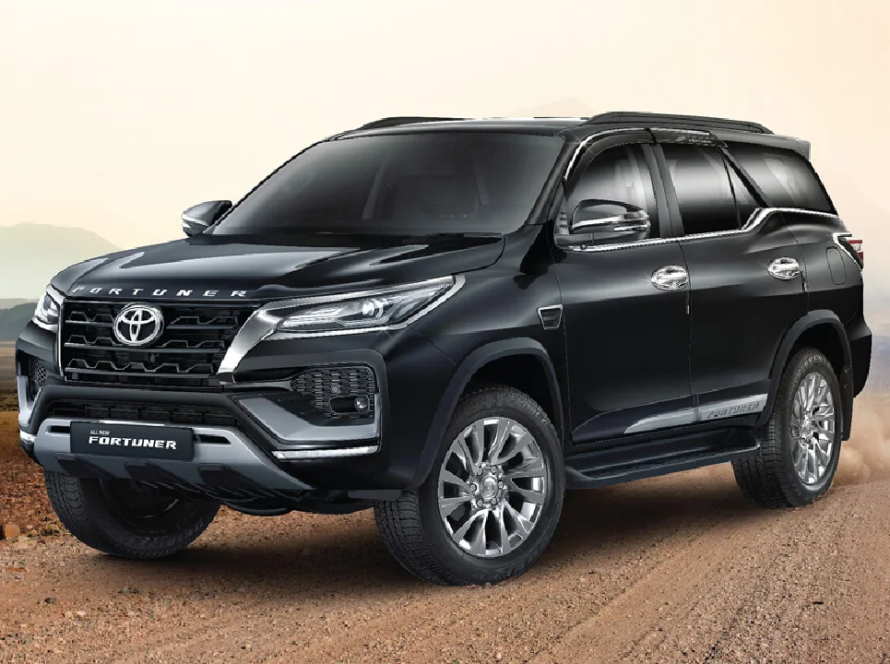
PPF earns its cost when the car and the ownership plan justify it. If your car is priced above ₹10 to ₹12 lakh, think Hyundai Creta, Toyota Fortuner, Mercedes-Benz GLC or BMW X1, and you plan to keep it for five or more years, PPF protects that investment in a way ceramic coating cannot. Owners who want to avoid repainting panels, avoid losing resale leverage over chipped paint, and avoid permanent highway damage generally find PPF to be the better long-term choice.
Why Aegis PPF Is the Best Paint Protection Film Range for Indian Cars
Aegis is a dedicated PPF brand, not a general detailing studio, and that focus is what makes Aegis PPF the best paint protection film range for Indian roads and climate. A few things that shape how we build our films:
Premium TPU construction: We build Aegis PPF on high-grade thermoplastic polyurethane rather than cheaper TPH or PVC alternatives, which tend to yellow and turn brittle faster. TPU stays flexible through the expansion and contraction Indian summers put metal panels through.
Weather-focused formulation: India’s UV levels are harsh. Our films use UV inhibitors that keep your car’s colour true and the film optically clear over time, with non-yellowing performance as a core requirement, not an afterthought.
A responsive self-healing top coat: Whether it is swirl marks from a local wash or light scratches, the self-healing layer works at lower temperatures so your car keeps its finished look without constant correction.
Hydrophobic top coat as standard: Every Aegis PPF installation includes a built-in hydrophobic top coat, so you get easier cleaning without paying extra for it.
High-gloss clarity with no orange peel texture: Aegis PPF is engineered to enhance paint depth rather than dull it, so the finish holds up against a ceramic-coated look.
Studio network and warranty support: We back our films with manufacturer warranty support through a certified studio network across India.
In Conclusion
If your car is priced under ₹10 to ₹12 lakh and your main goal is a showroom-fresh shine with easier upkeep, ceramic coating is probably the right starting point. If you want real protection against stone chips, scratches and the wear that comes from daily Indian roads, and you plan to keep the car for years, PPF should be your priority. If you want both, pairing ceramic coating over PPF gives you gloss and protection together.
FAQs
1. Is PPF better than ceramic coating in India?
For impact and scratch protection, yes, PPF performs better. Ceramic coating mainly improves gloss and water repellence rather than physical protection.
2. PPF vs ceramic coating, which is better for a car under ₹10 to ₹12 lakh?
Ceramic coating usually makes more sense here. PPF costs more than the value it adds at this price point, unless you drive on rough highways often or plan to keep the car for many years.
3. How much does PPF cost compared to ceramic coating in India?
Ceramic coating usually costs ₹8,000 to ₹50,000 depending on car size and product grade. Full-body PPF usually costs ₹61,750 to ₹2,80,000 or more, depending on film grade and coverage. Get a studio quote for your specific car, since prices vary by city and installer.
4. Does ceramic coating prevent stone chips?
No. Its layer is too thin to absorb meaningful impact, so the paint underneath can still chip.
5. How long does PPF last in India?
High-quality PPF typically lasts 5 to 10 years depending on film grade, installation quality and maintenance.
6. Does PPF damage the original paint?
No. Properly installed and properly removed PPF does not damage factory paint.
7. Can I use PPF and ceramic coating together?
Yes. Applying a ceramic top coat over PPF is common and gives you the impact protection of the film along with the gloss and easy cleaning of ceramic coating.
8. Which is better for resale value, PPF or ceramic coating?
PPF helps preserve the original paint condition, which supports resale trust and value more directly than ceramic coating does.