Mahindra XUV700 and XUV 7XO owners deal with the same paint risks every day: stone chips on the highway, gravel in unpaved lots and swirl marks from frequent handwashing. If you’ve just bought one, or are about to, you’re probably weighing whether paint protection film for Mahindra XUV700 models is worth the spend, and how much of the car needs covering.
This guide covers when PPF makes sense for both models, what decides the cost, how to judge a film properly and where Aegis Films fits in.
Table of Contents
- Quick Summary
- Why XUV700/XUV 7XO Suit PPF
- XUV700 vs XUV 7XO for PPF Buyers
- Areas to Protect First
- Full-Body or Partial Coverage
- XUV700 PPF Cost
- What Makes One PPF Better
- Why Aegis Suits Mahindra Owners
- PPF vs Ceramic Coating
- Is PPF Worth It?
- Other Mahindra SUVs
- Questions to Ask
- Talk to Aegis Films About PPF for Your Mahindra
- FAQs
Quick Summary
- PPF makes the most sense for highway driving, outdoor parking and long-term ownership, though city-only use sees less benefit
- Partial coverage on the bumper, bonnet, fenders and ORVMs handles most everyday risk at a lower cost than full-body protection
- Full-body PPF suits owners who want every panel covered and zero visible film lines, especially before resale
- XUV700 PPF costs range from roughly ₹60,000 for partial coverage to over ₹2,80,000 for premium full-body films
- Film thickness alone doesn’t guarantee durability; construction quality, topcoat and installation skill matter just as much
- P.PF physically absorbs chips and scratches, while ceramic coating adds gloss and makes cleaning easier without preventing impact damage
- PPF and ceramic coating can be combined for both protection and shine, as long as the ceramic product is compatible with the film
1. Why PPF is a Worthy Investment for Mahindra XUV700 and XUV 7XO
The XUV700, and now the XUV 7XO, cover a lot of ground for most owners. The bonnet and front fenders sit directly in the path of stone chips and road debris, especially on highway stretches and under-construction roads common across Indian cities.
Parking adds to this. Owners who park outdoors or in tight spaces deal with door dings, gravel bounce and dust that settles into fine scratches over time. Darker paint doesn’t attract more damage, but it shows swirl marks more visibly, which is often what makes owners notice wear sooner.
None of this makes an XUV700 inherently more scratch-prone because it’s an SUV. The exposure simply adds up over a typical ownership period, and PPF for Mahindra XUV700 owners is largely about slowing that wear down.
2. XUV700 vs XUV 7XO: What Changes for PPF Buyers
Mahindra launched the XUV 7XO in January 2026 as a mid-cycle update to the XUV700, not a full model change. The platform, engines and overall body carry over, with the update focused on the front fascia, lighting, interior tech and trim.
For PPF, this matters less than the name change suggests. Panel shapes on the bonnet, bumper, fenders and mirrors stay broadly similar, so coverage priorities carry over too.
What changes is search behaviour. Existing owners search for XUV700 PPF cost, while new buyers search for XUV 7XO PPF. Both are asking the same question, and this guide applies to either version.
3. Which Areas to Protect First
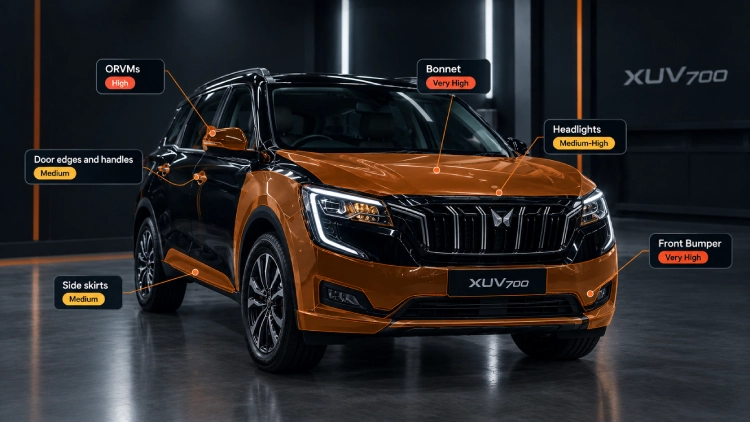
Not every panel carries the same risk. Use this as a starting point rather than a fixed rule.
| Area | Priority | Why |
|---|---|---|
| Front bumper | Very high | Direct exposure to stone chips and gravel |
| Bonnet | Very high | Long, flat surface facing oncoming debris |
| Front fenders | High | Catches debris kicked up by the front wheels |
| ORVMs | High | Frequent contact in tight parking and lane splitting |
| Headlights | Medium-high | Exposed to chips and costly to replace |
| Door edges and handles | Medium | Repeated contact from daily use |
| Side skirts | Medium | Road spray and kerb contact |
| Full body | Depends on owner | Relevant for long-term ownership or resale-focused owners |
The first four rows address most of the everyday risk on a tighter budget.
4. Full-Body PPF or Partial Coverage
Full-body PPF tends to make sense on a new XUV700 or XUV 7XO if you plan to keep it for several years, drive frequently on highways or park outdoors most of the time. It also gives a consistent finish across every panel.
Partial PPF works if your budget is limited, your driving is mostly urban, or your main concern is stone chips rather than everyday wear. Covering the bumper, bonnet, fenders and ORVMs handles the areas that take the most damage, at a lower cost.
Neither option is automatically better. It comes down to how the car is actually used.
5. XUV700 PPF Cost: What Decides the Price
There’s no single number for XUV700 PPF cost. Pricing depends on several variables rather than the vehicle alone:
- Film grade and construction, such as XG Series versus Clear PPF
- Coverage, partial versus full-body
- Finish, gloss versus matte
- Paint preparation needed before installation
- Panel complexity and vehicle size
- Installer and warranty terms
Aegis PPF pricing generally runs from around ₹60,000 for entry-level film to over ₹2,80,000 for premium film with full coverage. Given the XUV700’s size, full-body coverage tends to sit toward the mid-to-upper end of that range, though an exact figure needs a quote.
6. What Actually Makes One PPF Better Than Another
Film thickness gets most of the attention, but it’s only one part of the picture. Material quality is just as important; the base material, the topcoat and how the layers are engineered together decide how a film performs.
A well-built film with a strong topcoat can outperform a thicker film that’s poorly made or poorly fitted. Judge a film on self-healing behaviour, optical clarity, UV resistance and edge finishing, not just its micron count.
Thicker PPF is not automatically better PPF. Installation quality mostly affects the final result more than the number on the spec sheet.
Why Aegis Films Suits Mahindra Owners
The Aegis XG Series fuses Polycarbonate with TPU, suited to owners who want stronger impact resistance on high-exposure panels. Clear PPF carries a heat-activated self-healing topcoat that responds to marks from around 60°C. For a different look, Matt PPF adds an anti-glare, anti-fingerprint finish.
Film quality is only half the equation. Aegis PPF is fitted by trained technicians across its certified studio network, and every installation is registered digitally under Aegis’s Pan-India warranty. Film choice and consistent installation determine how PPF looks a year or two later, not just the brand on the box.
PPF vs Ceramic Coating
| Features | PPF | Ceramic Coating |
|---|---|---|
| Physical barrier | Yes | No |
| Stone-chip protection | Stronger | Limited |
| Gloss and hydrophobic finish | Depends on film and topcoat | Strong |
| Self-healing | Available on suitable films | Not comparable |
| Easier cleaning | Yes | Yes |
| Primary purpose | Physical paint protection | Surface gloss and easier maintenance |
PPF and ceramic coating solve different problems rather than competing with each other. If stone chips worry you most, PPF is the more relevant choice. If gloss and easier washing matter more, ceramic coating fits better. Some owners use both. Our PPF vs ceramic coating comparison covers this in more depth.
Is PPF Worth It for Your Mahindra?
There’s no automatic yes here. Weigh it against your own ownership pattern:
- How long you plan to keep the car
- How much highway driving you do
- Whether you park outdoors or under cover
- How much cosmetic wear bothers you
- Your budget for paint preservation versus other priorities
Worth being upfront about: PPF preserves your original paint, which can support the car’s presentation at resale, but the film cost shouldn’t be expected to come back in full. Treat it as protecting what you already have, not an investment that pays for itself.
Other Mahindra SUVs Worth Considering
The same reasoning applies beyond the XUV700 and XUV 7XO. Owners of the Scorpio-N, Thar ROXX, BE 6 and XEV 9e face similar decisions on exposure, parking and ownership length. See our guide to the best PPF for the Mahindra BE6 for the same framework applied to that model.
Questions to Ask Before You Buy
- What is the film made from, and what’s the topcoat?
- What does the warranty cover, and what does it exclude?
- Does the film have a self-healing topcoat?
- How is the paint prepared before installation?
- Are vehicle-specific patterns used?
- How are edges finished around curves and trim?
- Who handles warranty support if something goes wrong?
You might also like: Top 10 Common Questions About PPF
Talk to Aegis Films About PPF for Your Mahindra
The right PPF for your XUV700 or XUV 7XO comes down to your driving pattern, budget and ownership length, not the film with the biggest warranty number. Talk to the Aegis Films team about the right coverage and film for your vehicle.
Frequently Asked Questions
1. Is PPF worth it for a Mahindra XUV700?
Yes, if you drive frequently on highways, park outdoors or plan to keep the car for several years. It matters less for city-only use.
2. How much does XUV700 PPF cost?
Roughly ₹60,000 to over ₹2,80,000, depending on the film, coverage and vehicle.
3. Is PPF different for the XUV 7XO compared to the XUV700?
Not materially. The 7XO is a mid-cycle update, so panel shapes and coverage priorities are largely unchanged.
4. Is thicker PPF always better?
No. Construction, topcoat quality and installation matter just as much as thickness.
5. Should I choose full-body or partial PPF?
Full-body suits owners who want every panel protected. Partial coverage on the bumper, bonnet, fenders and ORVMs handles most everyday risk for less.
6. Can PPF and ceramic coating be used together?
Yes, if the ceramic product is compatible with the film underneath.
7. Does PPF prevent all scratches?
No. It reduces chips and light scratches from everyday driving, but it isn’t a shield against deep scratches or serious impact.