Buying a new car is exciting. Keeping its paint looking new on Indian roads is a different challenge.
Dust, loose gravel, road debris, tight parking spaces, bird droppings and frequent washing can all leave their mark on your paint. This is where paint protection film PPF can help.
But choosing PPF is not as simple as picking the thickest film or the cheapest package. The film’s construction, installation quality, coverage and warranty all matter.
If you are considering PPF coating for cars, here are 10 things worth checking before you spend your money.
Table of Contents
- Key Takeaways
- Know What PPF Actually Does
- Think About Your Driving Conditions
- Look Beyond the Thickness
- Understand the Self-Healing Technology
- Compare Coverage, Not Just Price
- Installation Quality Matters as Much as the Film
- Read What the Warranty Actually Covers
- Know the Difference Between PPF and Ceramic Coating
- Choose the Finish You Actually Want
- Look at the Total Value, Not Just the Price
- Talk To Team Aegis Films To Know About The Best PPF For Your Car
- Frequently Asked Questions
Key Takeaways
- PPF is a protective barrier for everyday wear, not a shield against dents or serious impact damage
- Film thickness alone doesn’t tell the full story; the material, topcoat and overall construction decide how well a film performs
- Self-healing tech handles light surface marks; deeper scratches and cuts still need proper repair
- Coverage varies a lot between quotes; two similarly priced packages can protect very different parts of the car
- Installation quality can make or break even a premium film; check an installer’s edge work and complex panels before committing
- A long warranty period means little if it doesn’t cover the kind of damage you’re actually worried about
- PPF and ceramic coating solve different problems: one absorbs impact, the other adds gloss and easier maintenance
- Matte and gloss finishes change how the car looks, not just how well it’s protected
- Total cost swings widely based on vehicle size, film choice, coverage and warranty, not just a flat “PPF price”
- The right pick comes down to your driving conditions, how long you’re keeping the car and your budget for protecting the original paint
1. Know What PPF Actually Does
So, what is car paint protection film?
PPF, or paint protection film, is a transparent protective film applied directly over a vehicle’s painted surfaces. Most modern films use Thermoplastic Polyurethane (TPU) as their primary material.
The film creates a physical barrier between the paint and everyday hazards such as stone chips, minor scratches, road debris, UV exposure and contaminants.
Aegis Paint Protection Film is designed with features such as self-healing, stain resistance and optical clarity for everyday vehicle use.
The important thing to understand is that PPF is a protective layer, not a forcefield. It can help reduce paint damage from everyday driving, but it cannot make your car immune to deep scratches, dents or serious impacts.
2. Think About Your Driving Conditions
The best PPF car coating for one owner may not be the best choice for another.
Think about where your car spends most of its time.
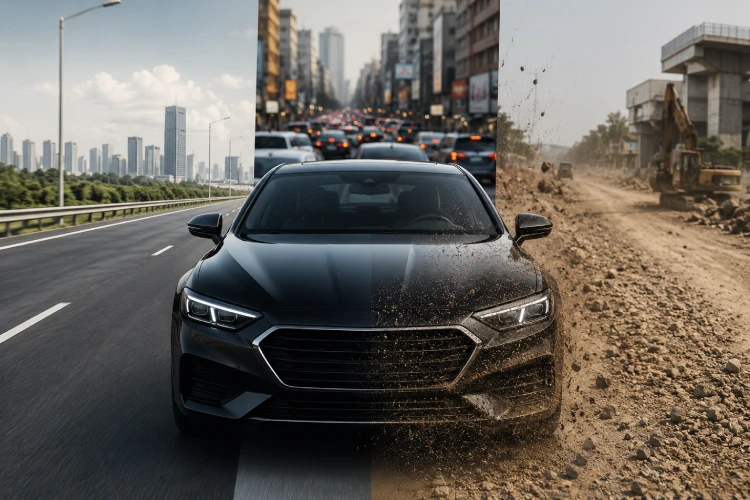
If you regularly drive on highways, the front bumper, bonnet, front fenders and ORVMs face greater exposure to stones and road debris. If you mainly drive through busy city streets, parking areas and narrow roads, door edges, handles and other high-contact areas may need more attention.
Indian road conditions also vary considerably between cities. Construction zones, loose gravel, uneven roads and dusty environments can all increase everyday exposure.
So before buying PPF, consider your actual driving pattern rather than choosing a package simply because it is the one most commonly recommended.
3. Look Beyond Film Thickness
Film thickness gets a lot of attention when people compare PPF coating products. It does matter, but it is not the complete story.
The material, topcoat, adhesive, flexibility and overall construction also influence how a film performs.
For example, Aegis XG Series combines Polycarbonate with TPU. The construction is designed to bring together the impact resistance of Polycarbonate with the flexibility and self-healing characteristics of TPU.
That is why you should not compare PPF purely by asking, “How many microns is it?”
Ask what those microns are made of and how the complete film has been engineered.
A thicker film that is poorly manufactured or poorly installed is not automatically the better investment.
4. Understand Self-Healing PPF
Self-healing is one of the features buyers often look for in premium PPF.
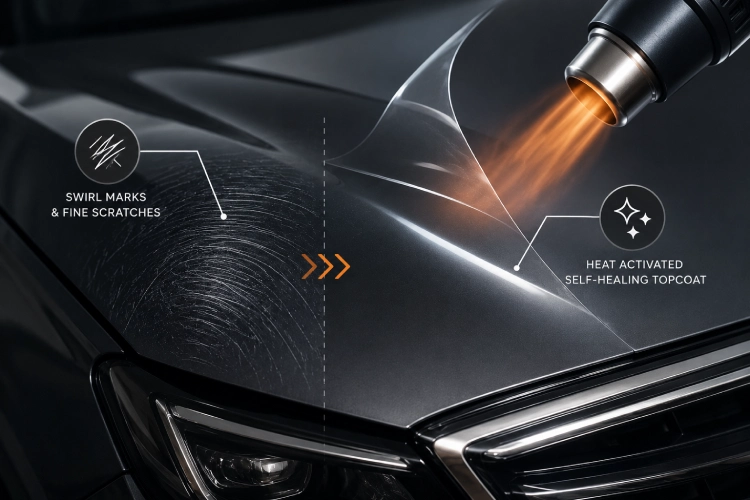
A self-healing topcoat can help minor surface scratches and swirl marks disappear when exposed to heat. This can be particularly useful for everyday marks caused by washing or light surface contact.
Aegis Clear PPF uses a heat-activated self-healing layer designed to respond to temperatures as low as 60°C.
But there is an important limitation.
Self-healing does not mean the film can repair everything. Light surface marks may heal, while deep scratches, cuts and serious physical damage will not simply disappear.
Think of self-healing as a useful surface technology rather than a guarantee against damage.
5. Compare Coverage, Not Just Car PPF Cost
This is where car PPF cost can become confusing.
Two installers can quote very different prices for what appears to be the same PPF package. The reason is often the amount of coverage rather than just the film itself.
Before comparing prices, ask exactly what is included.
Does the package cover the front bumper and bonnet? Does it include the front fenders, ORVMs, headlights, door edges and handles? Or does it cover the entire vehicle?
A useful way to think about PPF coverage is by impact zone:
| Area | Typical Exposure | PPF Priority |
|---|---|---|
| Front bumper | Stone chips and gravel | High |
| Bonnet | Stone chips and road debris | High |
| Front fenders | Road debris | High |
| ORVMs | Scratches and contact | High |
| Doors | Rubbing and minor scratches | Medium |
| Door edges and handles | Frequent contact | Medium |
| Roof | Lower impact exposure | Low |
| Boot and rear panels | Lower impact exposure | Low |
A cheaper package may simply protect fewer areas.
If your budget does not allow full-body PPF, a well-planned partial package can still protect the panels that face the most exposure.
6. Installation Quality Matters as Much as the Film
Even premium PPF coating for a car can look disappointing when it is installed poorly.
The film needs to follow the vehicle’s contours accurately. Poor installation can result in visible edges, wrinkles, bubbles or misaligned sections.
Wrapping edges properly also matters. Areas around bumpers, mirrors, door edges and complex body lines require careful handling.
Aegis PPF is installed through trained technicians across the certified CarzSpa network, making the installer’s workmanship an important part of the buying decision.
Before choosing an installer, look at their previous work. Check the edges, corners and difficult panels rather than judging the installation only from photographs of the finished car.
7. Read the PPF Warranty Carefully
Never choose a film simply because someone says it comes with a “10-year warranty” or “lifetime warranty”.
Read what the warranty actually covers.
A PPF warranty may cover manufacturing-related problems such as discolouration, cracking, blistering or delamination. It may not cover damage caused by road debris, accidents, incorrect cleaning or physical abuse.
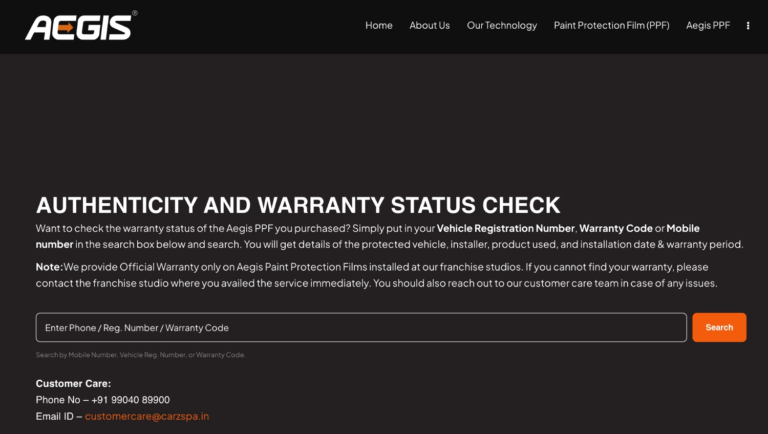
Aegis registers installations digitally under its Pan-India warranty, allowing customers to check their installation and warranty information.
The important question is not just “How long is the warranty?”
Ask:
What happens if something goes wrong and is it covered under the warranty terms?
8. Know the Difference Between PPF and Ceramic Coating
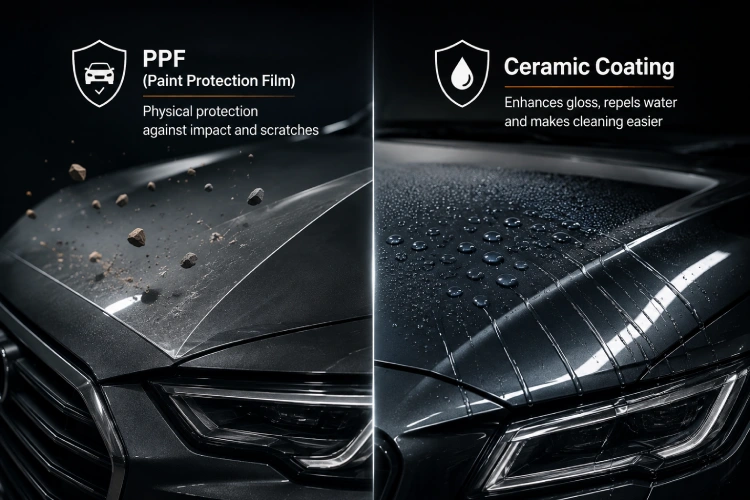
PPF and ceramic coating are often mentioned together, but they do different jobs.
PPF is a physical film designed to provide a protective barrier against stone chips, scratches and road debris.
Ceramic coating is a liquid coating applied to the vehicle’s surface. Its main benefits are gloss, hydrophobicity and easier cleaning. It does not provide the same level of physical impact protection as PPF.
So which one should you choose?
If stone chips and physical paint damage are your main concern, PPF is the more relevant option.
If your priority is gloss, water behaviour and easier maintenance, ceramic coating may be more suitable.
Some owners use both. PPF can protect high-impact areas while ceramic coating can be applied to other painted surfaces or over compatible PPF.
9. Choose the Finish You Actually Want
PPF is not limited to one appearance.
Gloss PPF is the traditional choice if you want to retain the original shine of your vehicle while adding protection.
Matte PPF gives the vehicle a different visual character. Aegis Matt PPF is designed to provide a matte appearance along with features such as anti-glare and anti-fingerprint properties.
So think about what you want from your PPF car.
Do you want the protection to be almost invisible or do you want the film to change the appearance of the vehicle?
There is also no reason to assume PPF is only useful on exterior paint. Interior PPF can be used on selected interior surfaces where scratches and daily contact are a concern.
10. Look at the Total Value, Not Just the Price
Finally, ask yourself why you want PPF in the first place.
If you have bought a new premium car, plan to keep it for several years and care about preserving the original paint, PPF can be a sensible investment.
Current Aegis PPF pricing starts at roughly ₹60,000 for entry-level Clear PPF and can go beyond ₹2,80,000 for higher-end XG Series installations on larger vehicles. The final car PPF cost depends on the vehicle, film, coverage and warranty selected.
That means there is no single PPF price that makes sense for every car.
You also do not necessarily need full-body coverage.
For many owners, protecting the front bumper, bonnet, front fenders and ORVMs first can be a more practical approach when budget is a consideration.
The right decision depends on your car, your driving conditions, your parking situation and how long you intend to keep the vehicle.
Talk To Team Aegis Films To Know About The Best PPF For Your Car
The best PPF coating for car owners is not necessarily the thickest or most expensive option. It is the one that matches your car, driving conditions, coverage needs, and the level of protection you want.
You can find out exactly what the best PPF coating is for your car, just by scheduling a call with Team Aegis Films. Our professionals will not only help you find the best deal for your car but will also help you get the best PPF installation by finding your nearest CarzSpa studio. Get in touch with us today.
Frequently Asked Questions
1) Is PPF worth it for a car in India?
PPF can be worth it if protecting the original paint is a priority. It can be particularly useful for new cars, premium vehicles and cars that are driven frequently on highways or roads with loose debris.
It is not automatically necessary for every car owner. Your usage, budget and ownership plans should determine whether it makes sense.
2) How much does PPF cost for a car in India?
Car PPF cost can range from around ₹60,000 for entry-level films to more than ₹2,80,000 for premium films on larger vehicles. The final price depends on the film, vehicle size, coverage, finish and warranty.
Always compare the coverage and film specifications before comparing quotations.
3) How long does PPF last?
The lifespan of PPF depends on the film construction, installation quality, maintenance and exposure to the environment. Always check the manufacturer’s warranty and recommended care instructions rather than assuming every film has the same lifespan.
4) Does PPF really self-heal?
Yes, self-healing PPF can repair certain light surface marks when exposed to heat. However, deep scratches, cuts and serious physical damage cannot be expected to heal on their own.
5) Is PPF better than ceramic coating?
Neither is universally better. They protect against different things.
PPF provides physical protection against impacts, stone chips and scratches. Ceramic coating focuses more on gloss, hydrophobicity and easier maintenance.
6) How long does PPF installation take?
Installation time depends on the vehicle, coverage and complexity of the installation. A full-car installation generally requires more time than a partial PPF package because each panel needs careful preparation and application.