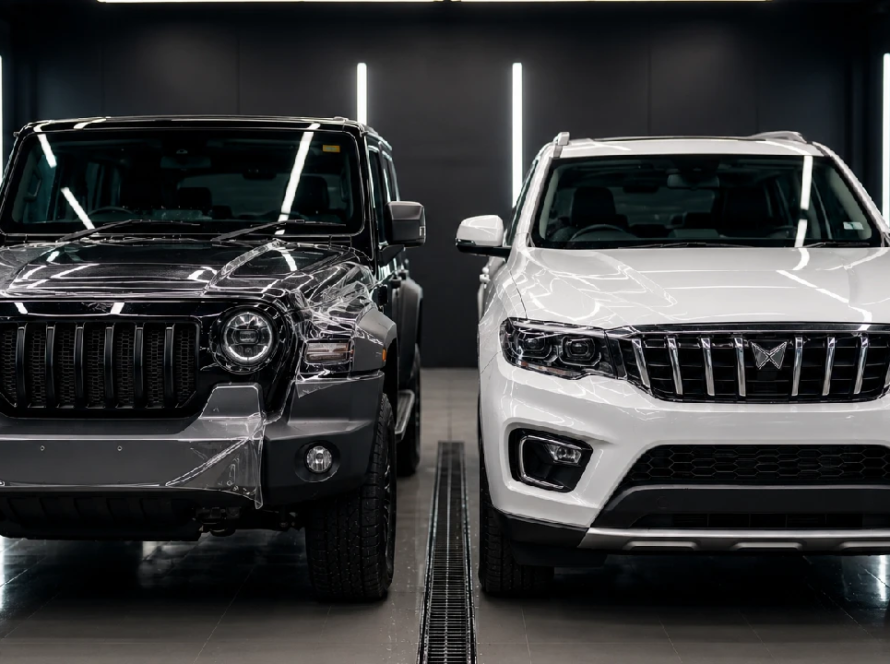
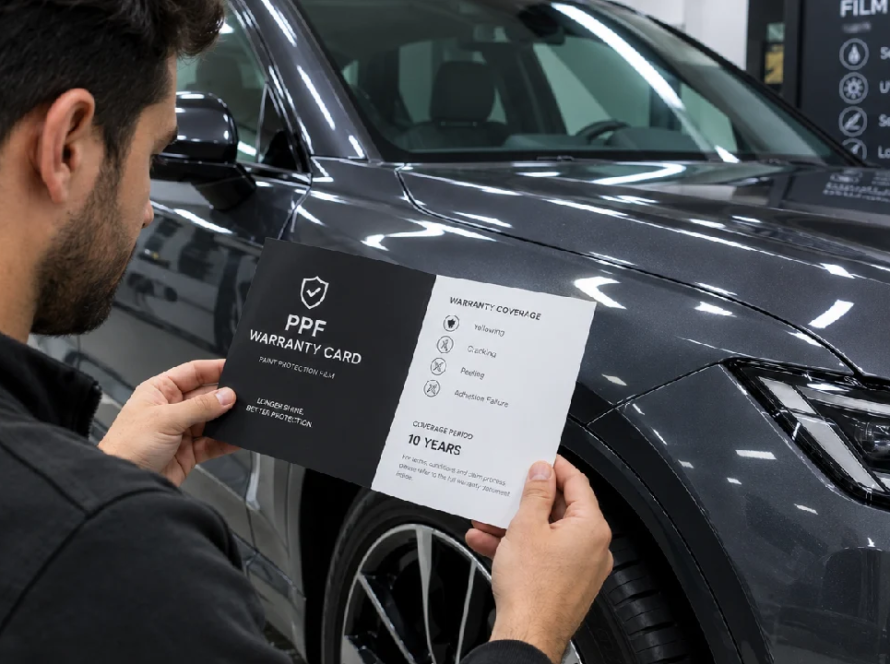
Ask five different installers about the types of car PPF available and you’ll probably get five different answers.
One will tell you TPU is the best paint protection film in India. Another will recommend TPH. Some will talk about gloss and matte finishes, while others will focus on full-body and partial-front packages. This often leaves car owners comparing completely different things without realising it.
The truth is that PPF can be categorised in multiple ways, including the material it’s made from, the finish it offers and the areas of the vehicle it protects. Understanding these categories is the key to choosing the right film and avoiding expensive mistakes.
In this guide, we’ll break down every major type of PPF available today and help you understand which one is right for your car.
Table of Contents
- What is Paint Protection Film (PPF)?
- What Are the Different Types of PPF?
- Why Should You Know All Types of PPF?
- Types of PPF Based on Material
- Types of PPF Based on Finish
- Types of PPF Based on Coverage
- PPF vs Ceramic Coating vs Vinyl Wrap: What’s the Difference?
- How to Choose the Right PPF for Your Car
- Why More Car Owners Are Choosing Premium TPU Films Like Aegis
- How Much Does Aegis PPF Cost in India?
- Final Thoughts
- Frequently Asked Questions
What is Paint Protection Film (PPF)?
Paint Protection Film is a transparent polyurethane-based film applied to a vehicle’s painted surfaces to protect them from:
- Stone chips
- Minor scratches
- Road debris
- Bug splatter
- Bird droppings
- Tree sap
- UV exposure
- Environmental contaminants
Interestingly, PPF did not originate in the automotive industry.
The technology traces its roots to military applications where protective films were used on helicopter rotor blades and aircraft surfaces exposed to harsh conditions.
Over time, advances in material science made it possible to create thinner, clearer and more durable films suitable for automotive paint protection.
Modern car PPFs are sophisticated multi-layer products rather than a simple plastic sheet.
A typical premium car PPF consists of:
- Top Coat: This outer layer provides stain resistance, hydrophobic properties and self-healing capabilities.
- Polyurethane Layer: This is the core protective layer responsible for absorbing impacts and resisting scratches.
- Adhesive Layer: The adhesive securely bonds the film to the vehicle’s paint while allowing safe removal when professionally handled.
- Release Liner: Removed during installation, this layer protects the adhesive before application.
What Are the Different Types of PPF?
Paint Protection Films are generally classified in three different ways:
Based on Material
- TPU PPF
- TPH PPF
- PVC PPF
Based on Finish
- Gloss PPF
- Matt PPF
- Satin PPF
- Coloured PPF
Based on Coverage
- Partial Front PPF
- Full Front PPF
- Track Pack PPF
- Full Body PPF
Among these, material type has the greatest impact on durability, clarity, self-healing performance and lifespan.
For most car owners seeking long-term protection, premium TPU PPF is widely considered the best paint protection film in India.
Why Should You Know All Types of PPF?
Imagine walking into a detailing studio and receiving three quotes:
- ₹40,000
- ₹85,000
- ₹1,80,000
All three are described as “PPF.”
Without understanding the differences, it may seem like one installer is simply charging more.
The reality is often very different.
Material quality, manufacturing processes, top-coat technology, adhesive systems, warranty coverage and installation standards can vary dramatically.
Understanding PPF types helps you:
- Avoid low-quality films
- Compare products fairly
- Select protection that matches your budget
- Achieve better long-term value
- Make informed decisions rather than relying on marketing claims
For enthusiasts who genuinely care about preserving their vehicle, this knowledge can save both money and frustration.
Types of PPF Based on Material
This is the single most important category when it comes to PPF selection. Everything else, like finish, coverage zone and thickness, is secondary to what the film is made of at its core. The base material determines longevity, clarity, flexibility, self-healing capability and ultimately, whether the film protects your paint for a year or a decade.
There are four material categories in the market today.
1. TPU PPF (Thermoplastic Polyurethane)
TPU is the gold standard base material for paint protection film and has been for over two decades. Thermoplastic Polyurethane is a polymer created by reacting a diisocyanate compound with a polyol, producing a material that combines the elasticity of rubber with the processability of plastic.
The result is a highly flexible film (it stretches and conforms to complex curves during installation), optically clear, impact-resistant and capable of carrying the self-healing topcoat technologies that define modern premium PPF.
Advantages of TPU PPF:
- Excellent impact and stone chip resistance
- Self-healing capability (in films with elastomeric topcoat)
- Superior optical clarity when manufactured from aliphatic compounds
- High flexibility conforms well to compound curves
- UV resistance in aliphatic grade: resists yellowing for 7-10+ years
- Long lifespan: typically carries 7-10 year warranties
Limitations:
- Higher cost than TPH or PVC
- Requires professional installation for best results
- Quality varies significantly between aromatic and aliphatic grades
Best for: Luxury cars, daily highway drivers, dark-coloured vehicles and anyone planning to own their car for five or more years.
Typical Lifespan: 5-7 years
2. TPH PPF (Thermoplastic Hybrid)
TPH stands for Thermoplastic Hybrid and it occupies the middle ground of the PPF market, cheaper than TPU, more capable than PVC. It is a blend of rubber and plastic polymers, engineered to achieve some of the flexibility and clarity of TPU at a lower manufacturing cost.
The important thing to understand about TPH is that it is not a type of polyurethane. It does not have the same molecular architecture as TPU. This means that while it can deliver basic paint protection, it cannot match TPU in the areas that matter most over time.
Most TPH films rely on plasticisers to achieve their transparency and softness. Over time, particularly under heat, those plasticisers leach out of the film. As they do, the film becomes stiffer, loses clarity and begins to yellow. The adhesive underneath also becomes harder to remove cleanly, which is why poorly-aged TPH film can leave residue marks on paint that require paint correction to fix.
Advantages of TPH PPF:
- Lower cost than TPU
- Better than PVC in flexibility and initial clarity
- Adequate stone chip and debris protection for short-term use
- Good for budget-conscious owners on lower-value vehicles
Limitations:
- Limited or no true self-healing
- Yellows faster than aliphatic TPU, especially in high-UV environments
- Shorter lifespan (3 to 5 years) under normal conditions, potentially less in Indian summers
- Adhesive can become difficult to remove cleanly after ageing
Best for: Budget-focused protection, entry-level or lower-value cars, shorter ownership cycles (under 3-4 years).
Typical Lifespan: 3-5 years
3. PVC PPF (Polyvinyl Chloride)
PVC-based paint protection film is the oldest category in the market and, by modern standards, the one that should be avoided entirely for any car you care about. Polyvinyl Chloride was used in early paint protection applications because it was cheap, widely available and easy to manufacture into thin films. However, its performance profile is fundamentally unsuitable for a product expected to protect paint over multiple years.
PVC has no meaningful elasticity compared to TPU. It cannot be formulated to carry a self-healing topcoat. It is highly susceptible to UV degradation, turning yellow and brittle within 12 to 24 months of exposure. When it does degrade, it often cracks, peels at the edges and leaves adhesive residue that bonds chemically with the clear coat, making removal a process that can cause serious paint damage.
Advantages:
- Cheapest option available
- Can provide very short-term physical protection against minor debris
Limitations:
- No self-healing capability
- Yellows and cracks within 1-2 years
- High risk of adhesive residue on removal
- Poor heat resistance, especially problematic in Indian summers
- Minimal flexibility, prone to cracking at panel edges and complex curves
Best for: Temporary use only.
Typical Lifespan: 1-2 years at most
4. Polycarbonate-TPU PPF
This is the most advanced category of PPF material currently available and it represents where the premium end of the industry is heading. Polycarbonate-TPU PPF is manufactured through a triple extrusion process that integrates polycarbonate, a material known for exceptional impact resistance and optical clarity (the same material used in aircraft windows and bullet-proof glass) into the TPU base layer.
The result is a material that takes TPU’s natural advantages and amplifies them. Where standard TPU is flexible, Polycarbonate-TPU is flexible and harder. Where standard TPU resists stone chips, Polycarbonate-TPU resists them with greater force before deforming. Where standard TPU is optically clear, Polycarbonate-TPU achieves even higher gloss and light transmittance values.
Aegis Films has been the pioneer of Polycarbonate-TPU PPF in India, introducing it under the XG Series. It is currently the only PPF product of its kind available in the Indian market, offering a level of protection and clarity that was simply not achievable with standard TPU films.
Advantages of Polycarbonate-TPU PPF:
- Superior optical clarity and gloss, noticeably higher than standard TPU
- Greater impact resistance: handles higher-velocity stone chips
- Enhanced self-healing performance
- Higher hydrophobicity is built into the topcoat
- Antiyellowing PPF
- Extended lifespan: carries lifetime warranties at the premium grade
TPU vs TPH vs PVC vs Polycarbonate-TPU
| Feature | PVC | TPH | TPU (Aliphatic) | Polycarbonate-TPU |
|---|---|---|---|---|
| Durability | Low | Moderate | Excellent | Superior |
| Flexibility | Low | Medium | High | High + Rigid impact layer |
| Optical Clarity | Poor (fades fast) | Average | Excellent | Best available |
| Self-Healing | None | Minimal | Yes (heat-activated) | Yes (enhanced) |
| UV / Yellowing Resistance | Very poor | Moderate | Excellent (aliphatic) | Excellent |
| Stone Chip Protection | Basic | Moderate | Excellent | Superior |
| Hydrophobic Performance | None | Basic | Good | Excellent |
| Lifespan | 1–2 years | 3–5 years | 3–7 years | 10 years to lifetime |
Types of PPF Based on Finish
Once you have decided on the right base material (which should almost always be aliphatic TPU for any car you care about), the next decision is the finish. The finish is determined primarily by the topcoat, which can be formulated to produce a range of visual appearances without changing the protective performance of the base layer.
1. Clear PPF
Clear PPF is the most widely installed type of paint protection film in India and globally. It is designed to be optically transparent, allowing the car’s original paint colour and finish to show through without any visible change in appearance. A well-installed quality gloss PPF is essentially invisible; from a few feet away, you cannot tell whether the car has film on it or not.
Clear PPF also enhances the car’s existing shine in many cases, because the hydrophobic topcoat creates a cleaner, more reflective surface than bare paint, acting like a permanent layer of detailing wax that also protects.
Best for: All car owners who want to preserve their factory paint finish. Metallic, pearl and solid colour paints all benefit equally. Clear PPF is the go-to choice for first-time PPF buyers, daily drivers and anyone investing in a new car.
2. Matt PPF
Matt PPF produces a non-reflective surface, either preserving an existing matt paint’s appearance or converting a glossy car to a matt look without any repainting. This is achieved through a topcoat that is micro-textured at the surface level, scattering light rather than reflecting it directionally.
From a protection standpoint, Matt PPF offers identical physical protection to clear PPF, the same base material, the same stone chip resistance and the same impact absorption. The only difference is the topcoat texture and finish appearance.
There are two distinct use cases for Matt PPF in India. The first is on factory matt-finish cars, which need a film that preserves the matt appearance rather than adding shine. The second and growing use case is on standard gloss cars, where the owner wants to change the aesthetic to a more understated, stealthy look without the permanence of a respray. This is especially popular on white, grey and blue cars.
Best for: Factory matt-finish vehicles, cars where the owner wants a matt aesthetic transformation and premium and luxury SUV owners who want a distinctive look.
3. Satin PPF
Satin PPF sits between gloss and matte on the reflectivity spectrum and it is a finish that almost every competing guide in India has overlooked entirely. It provides a soft, low-sheen finish that has more depth and richness than matte but lacks the high-gloss mirror effect of a standard clear film.
The visual effect is often described as looking like paint that has been satin-coated. There is reflection and depth. It is particularly effective on dark colours: a dark grey or midnight blue car with satin PPF has a visual presence that neither full gloss nor full matt can replicate.
Best for: Performance cars, dark-coloured vehicles, enthusiasts who want a unique aesthetic without committing fully to matte.
4. Coloured / Tinted PPF
Coloured PPF is paint protection film with pigment incorporated directly into the film, typically in the TPU base layer or as a bonded colour coat that simultaneously protects the paint underneath and changes the visible colour of the car. It is, in effect, a full-colour change solution that also provides genuine PPF-grade protection.
Best for: Car enthusiasts who want a colour change without repainting, protecting a factory paint that the owner wants to cover for resale and unique personalisation on any car type.
Types of PPF Based on Coverage
Partial / Impact Zone PPF
The most budget-conscious coverage option. Covers the highest-risk areas for stone chips and abrasion: typically the door cup areas, door edges, door sills and lower bumper sections. This is not the same as front PPF; it targets the specific zones that accumulate the most incidental damage in urban environments.
Best for: Owners on a tight budget who want to protect the most vulnerable micro-zones. Most effective in city-use cars that do not cover significant highway distances.
Full Front PPF
The most popular coverage choice in India and for most car owners the best balance of protection and investment. Full front PPF covers the entire bonnet, the front bumper in full, both front fenders, the wing mirrors and the headlights. These are statistically the surfaces that absorb the most stone chips and highway debris impact; the bonnet and front bumper take the direct hit from any stone thrown up by cars in front.
Full front protection on an average mid-size SUV like the Creta or XUV700 typically covers around 25 to 30% of the car’s total painted surface but provides protection for 70 to 80% of the high-risk exposure.
Best for: Daily drivers, highway commuters, the most popular choice for protecting a new car investment.
Full Body PPF
Full body PPF covers every painted surface of the car, all panels, all bumpers, mirrors, door handles, pillars, the boot, the roof. It provides the maximum possible protection for the factory paint and creates a completely uniform appearance across the entire car.
The case for full body PPF is strongest for luxury and exotic vehicles where the factory paint is either rare, expensive to repair or both. It also makes a strong financial argument for cars that will be kept for seven or more years: the cost of full body PPF is typically recovered in reduced paint repair costs and significantly higher resale value, since the original paint is in factory-fresh condition.
Best for: Luxury and exotic vehicles, new car owners planning long-term ownership, cars in high paint-damage risk environments (coastal cities, construction-heavy urban areas, frequent highway users).
PPF vs Ceramic Coating vs Vinyl Wrap: What's the Difference?
One of the most common questions car owners ask before committing to PPF is how it compares to ceramic coating and vinyl wrap. The short answer: these are not competing products. They serve fundamentally different purposes and in many cases, the smartest protection strategy combines more than one.
Here is how they stack up:
| Feature | PPF | Ceramic Coating | Vinyl Wrap |
|---|---|---|---|
| Primary Function | Physical impact protection | Chemical and UV protection | Colour change/aesthetics |
| Protects Against Stone Chips | Yes | No | Limited |
| Self-Healing | Yes (premium TPU) | No | No |
| UV Protection | Yes | Yes | Partial |
| Hydrophobic Properties | Yes | Yes (superior) | No |
| Changes Car Colour | Yes (coloured PPF only) | No | Yes |
| Thickness | 165–400 microns | 0.5–2 microns | 60–100 microns |
| Durability | 3 years to lifetime | 2–5 years | 2–3 years |
| Cost (Full Body, India) | ₹61,750 – ₹2,80,000+ | ₹15,000 – ₹45,000 | ₹40,000 – ₹1,20,000 |
| Best For | Long-term paint preservation | Gloss enhancement and easy maintenance | Temporary personalisation |
How to Choose the Right PPF for Your Car
| If You Are A... | Recommended Material | Recommended Finish | Recommended Coverage |
|---|---|---|---|
| First-Time Car Owner (e.g., Baleno, i20, Brezza) | Pure TPU | Ultra-Clear Gloss | Full Front Package |
| Luxury Car Owner (e.g., Mercedes C-Class, BMW 5, Audi A6) | Premium Aliphatic TPU | High-DOI Gloss | Full Body Coverage |
| Active SUV Owner (e.g., Harrier, Scorpio-N, Fortuner) | Premium Aliphatic TPU | Gloss or Satin | Full Body / Full Front + Rockers |
| Performance Car Enthusiast (e.g., Octavia vRS, M340i) | Premium Aliphatic TPU | Gloss or Satin | Full Body / Track Pack |
| Matte Paint Vehicle Owner (e.g., Kia X-Line models) | Premium Aliphatic TPU | Textured Matte | Full Body Coverage (Mandatory) |
| Styling & Customization Enthusiast | Pigmented Coloured TPU | Coloured Gloss/Satin | Full Body Color Transformation |
The Step-by-Step Guide To Choosing The Right PPF For Your Car
Follow this simple, logical mental path to figure out your ideal setup:
Step 1: How long do you plan to keep the vehicle?
- Less than 3 years: A high-grade TPU film is advisable as it offers optimum protections and preserves resale value of your car.
- More than 3 years: True Aliphatic TPU is highly recommended. Anything less will break down, turn yellow and require a costly, risky removal process before you sell the car.
Step 2: Do you prioritise factory aesthetics or a bold style transformation?
- Factory Aesthetics: Opt for Clear Gloss PPF to highlight your original paint or select matt/Satin PPF if your car came with factory matt paint.
- Bold Style Transformation: Choose a premium Coloured TPU PPF to completely safely switch up the look of your vehicle while gaining heavy-duty impact protection.
Step 3: What are your frequent driving conditions and routes?
- Heavy Highway Commuting: You face high-velocity stone chips. Go for Full Front PPF as your absolute minimum benchmark if you are under budget. IF you are open to invest more, full PPF is often advisable.
- Purely Urban Traffic & Tight City Parking: You face minor bumper scrapes, tight squeezes and environmental stains. A Full Front or Full Body setup will keep those high-traffic panels looking clean.
Why More Car Owners Are Choosing Premium TPU Films Like Aegis
As Indian consumers become more informed about PPF technology, demand for premium TPU-based solutions continues to grow.
Modern enthusiasts are no longer looking solely at price. They are evaluating:
- Material quality
- Long-term durability
- Self-healing performance
- Optical clarity
- Installation standards
- Warranty support
This is where brands such as Aegis Films have gained attention within the detailing industry.
Aegis focuses on premium TPU-based paint protection solutions engineered for Indian driving conditions. Features such as self-healing technology, hydrophobic performance, UV resistance and advanced top-coat systems help address many of the challenges Indian vehicles face daily.
Combined with professional installation standards, these characteristics make premium TPU films a compelling option for enthusiasts who view paint preservation as a long-term investment rather than a short-term expense.
Types of Aegis PPF
Aegis Films offers a comprehensive range of paint protection films designed to cover every car type, driving profile and budget. Every product in the Aegis range is built on aliphatic TPU with a hard top coat, engineered specifically to handle Indian heat, humidity and road conditions.
| Product | Range | Type | Thickness | Warranty |
|---|---|---|---|---|
| Core | Clear PPF | Gloss | 180 microns | 3 years |
| Armor | Clear PPF | Gloss | 190 microns | 5 years |
| SPX | Clear PPF | Gloss | 210 microns | 7 years |
| Matt | Matt PPF | Matte Finish | 190 microns | 5 years |
| Matt Pro | Matt PPF | Matte Finish | 190 microns | 7 years |
| Prism | Coloured PPF | 50+ Colour Options | 190 microns | 7 years |
| Xceed | XG Series (Polycarbonate-TPU) | Gloss | 225 microns | 10 years |
| Ultra 250 | XG Series (Polycarbonate-TPU) | Gloss | 250 microns | 12 years |
| Eternal 300 | XG Series (Polycarbonate-TPU) | Gloss | 300 microns | Lifetime |
The XG Series, comprising Xceed, Ultra 250 and Eternal 300 represents the most advanced PPF technology currently available in India. Built through a triple extrusion process that fuses polycarbonate into the TPU base, the XG Series delivers superior impact resistance, higher optical clarity and longer-lasting performance than standard TPU films.
To ensure the best possible outcome, all Aegis PPF products are exclusively installed at CarzSpa Detailing Studios across India. This is a deliberate choice: a premium film deserves equally premium installation expertise and the partnership between Aegis Films and CarzSpa ensures that the quality engineered into every roll is fully realised on your car.
How Much Does Aegis PPF Cost in India?
Pricing for Aegis PPF is based on four variables: the product tier, vehicle size, coverage area and installation complexity. The table below reflects full-body installation pricing across the Aegis range for reference.
| Product | Small | Medium | Large | XL |
|---|---|---|---|---|
| Core (Clear, 3-yr) | ₹61,750 | ₹71,500 | ₹81,250 | ₹91,000 |
| Armor (Clear, 5-yr) | ₹76,000 | ₹88,000 | ₹1,00,000 | ₹1,12,000 |
| SPX (Clear, 7-yr) | ₹95,000 | ₹1,10,000 | ₹1,25,000 | ₹1,40,000 |
| Matt (5-yr) | ₹76,000 | ₹88,000 | ₹1,00,000 | ₹1,12,000 |
| Matt Pro (7-yr) | ₹95,000 | ₹1,10,000 | ₹1,25,000 | ₹1,40,000 |
| Prism Coloured (7-yr) | ₹1,61,000 | ₹1,87,000 | ₹2,12,000 | ₹2,38,000 |
| Xceed XG (10-yr) | ₹1,23,500 | ₹1,43,000 | ₹1,62,500 | ₹1,82,000 |
| Ultra 250 XG (12-yr) | ₹1,61,500 | ₹1,87,000 | ₹2,12,500 | ₹2,38,000 |
| Eternal 300 XG (Lifetime) | ₹1,90,000 | ₹2,20,000 | ₹2,50,000 | ₹2,80,000 |
All prices are indicative and inclusive of professional installation at CarzSpa Studios. Prices are subject to revision; for the most current pricing, visit aegisfilms.in or contact your nearest CarzSpa studio.
Final Thoughts
Every car enthusiast remembers the day they collected their vehicle from the showroom. The paint looked flawless. The reflections were sharp. Every panel felt perfect.
The challenge is keeping it that way.
Understanding the different types of PPF allows you to move beyond marketing buzzwords and choose a solution that genuinely matches your driving habits, ownership plans and expectations.
For most modern car owners, premium TPU car PPF remains the benchmark. It delivers the best balance of protection, clarity, self-healing performance and long-term value. Whether you prefer a factory-fresh gloss finish, a stealthy matt appearance or a bold coloured transformation, choosing the right PPF can help preserve the look and value of your vehicle for years to come.
After all, your car’s paint is original only once. Protecting it properly starts with choosing the right type of PPF.
Frequently Asked Questions
1. Which type of PPF is best?
Premium TPU PPF is widely considered the best option due to its durability, self-healing properties, clarity and longevity.
2. Is TPU better than TPH?
In most categories, yes. TPU generally offers superior flexibility, protection, self-healing and lifespan.
3. Does PPF prevent stone chips?
PPF significantly reduces damage from road debris and stone impacts, although no film can guarantee complete protection against every impact.
4. Does PPF turn yellow?
High-quality TPU films are designed to resist yellowing far better than older-generation materials.
5. Is coloured PPF better than vinyl wrap?
For owners seeking both appearance enhancement and paint protection, coloured PPF offers advantages over traditional vinyl wraps.
6. How long does PPF last?
Lifespan depends on material quality, maintenance and environmental conditions. Premium TPU films generally offer the longest service life.
7. Is full-body PPF worth it?
For luxury, performance and enthusiast-owned vehicles, full-body coverage often provides the most comprehensive protection.
8. What are the different types of PPF available for cars?
PPF is categorised in three ways: by material (TPU, TPH, PVC, Polycarbonate-TPU), by finish (clear/gloss, matt, satin, coloured) and by coverage area (partial, full front, full body). Material quality has the greatest impact on long-term performance.
9. Is PPF 100% safe for your car’s original paint?
Yes, when you choose a high-quality film and have it installed by a certified professional. Premium aliphatic TPU films are designed to bond securely and release cleanly without damaging the clear coat. Risk only arises with low-grade films or improper removal.
10. What is the best PPF brand in India?
Aegis Films is widely considered the best paint protection film brand in India. It is the only PPF range engineered specifically for Indian conditions, backed by warranties from 3 years to lifetime and exclusively installed by trained technicians at 150+ CarzSpa studios nationwide.